3D Semantic Interface For AI Communication
Semantic Terrain turns AI interaction into a navigable knowledge space where concepts, evidence, questions, and outputs can be arranged, inspected, and challenged as semantic objects.

Text is precise, but it collapses complex thought into a scroll. Semantic Terrain studies an AI workspace where meaning can be moved, grouped, questioned, and remembered spatially.
Premise
Most AI systems still behave like messaging apps. The user types into a chronological thread, the model responds, and shared context becomes a long transcript. This works for direct questions. It weakens when the task requires synthesis across notes, conflicting claims, visual references, timelines, and unfinished intuitions.

Semantic Terrain makes the AI workspace navigable. Concepts become nodes. Evidence becomes anchored material. Questions become unresolved objects. Relationships become visible edges, territories, distances, and confidence states. The user can speak, type, drag, pin, annotate, and move through the structure.
This is not a 3D chatbot skin. The spatial layer must reveal relationships that a flat transcript hides.
Why It Matters
Human reasoning is not only linguistic. People externalize thought through whiteboards, maps, walls, timelines, moodboards, folders, and sketches. AI should be able to inhabit that kind of workspace instead of forcing every operation through a sentence.
A useful spatial AI interface could improve:
- Synthesis: adjacent ideas reveal patterns before they become verbal.
- Recall: location and visual grouping support memory.
- Critique: weak links, contradictions, and unsupported claims become inspectable.
- Creative direction: generated outputs remain attached to the concepts that produced them.
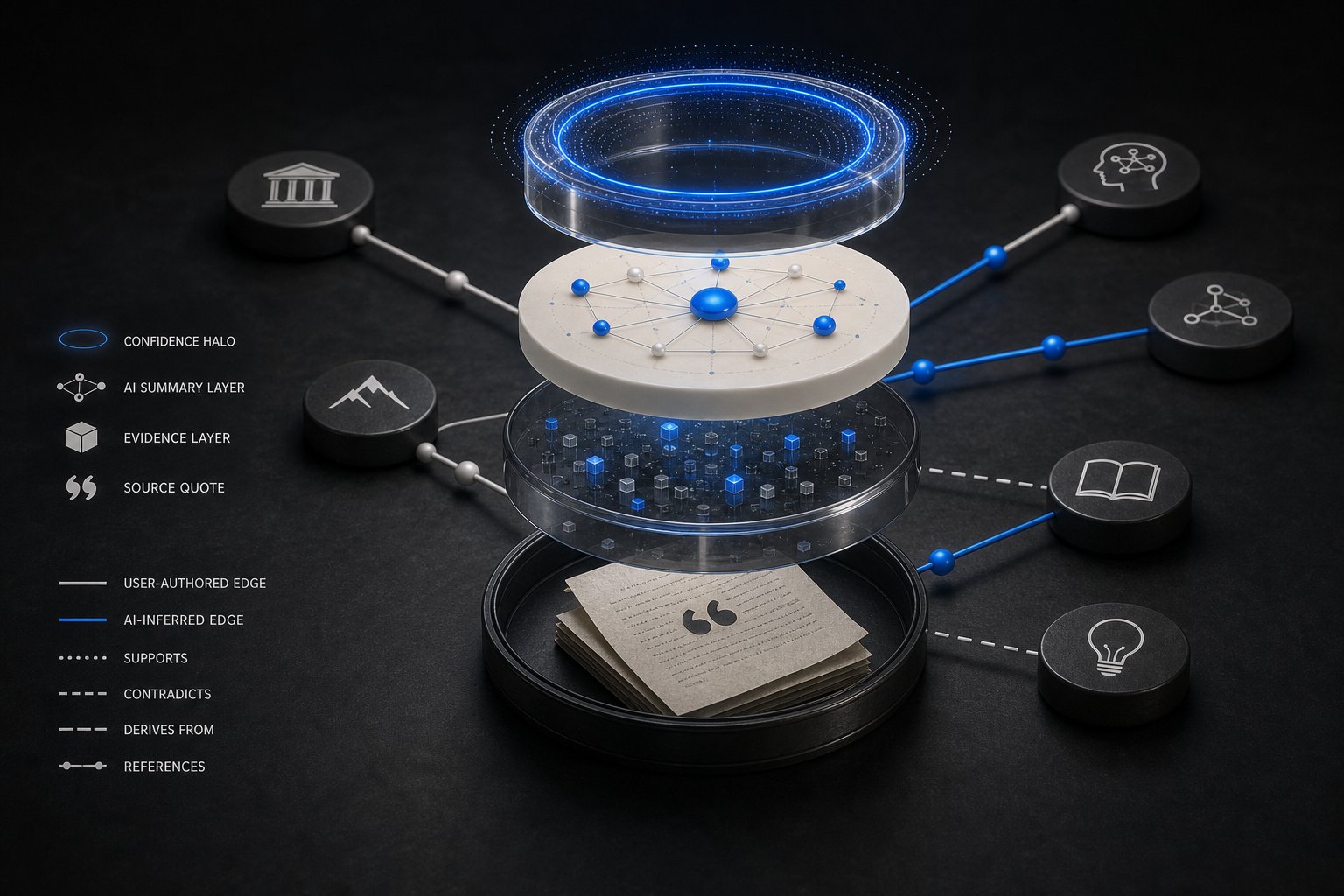
- Provenance: every object can show source, author, confidence, and transformation history.
The constraint is semantic fidelity. A beautiful map that lies is worse than a plain chat window. AI-inferred structure must remain visibly separate from user-authored structure.
How It Works
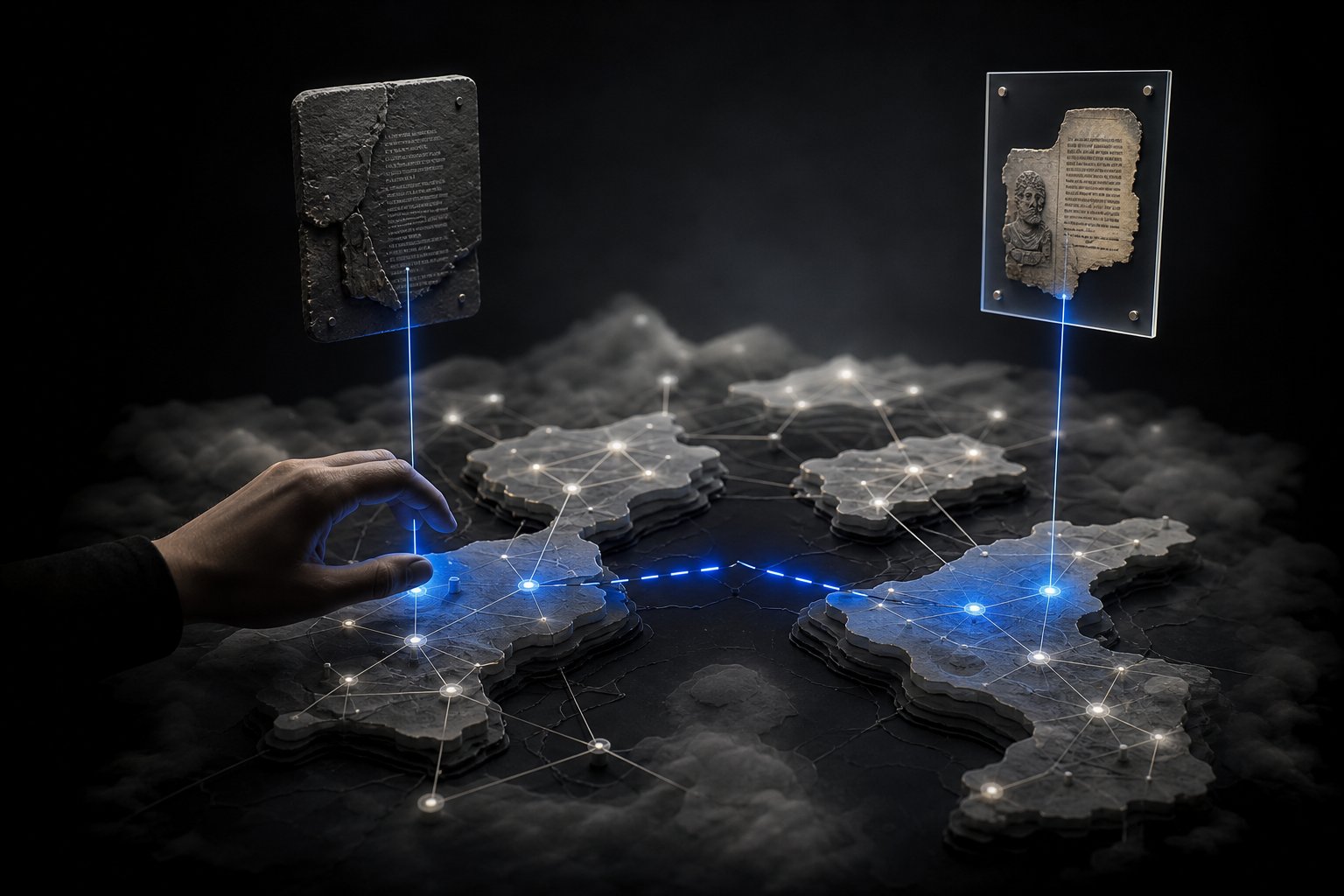
The system converts multimodal inputs into a shared semantic scene. Distance encodes similarity; edge type encodes relationship; opacity encodes confidence; elevation encodes abstraction.
- Text, voice, files, sketches, links, and generated media enter as source objects.
- Embeddings place related material near each other by semantic similarity.
- A graph database stores explicit relationships: supports, contradicts, derives from, expands, compresses, references.
- The LLM labels, summarizes, critiques, and proposes new connections.
- The 3D interface renders clusters as territories, with edges, labels, and confidence states kept visible.
- User edits become first-class structure, not temporary UI state.
Interaction stays hybrid. Typing remains the precision tool. Voice handles commands and fluid questioning. Spatial movement controls context.
Example operations:
- “Show only claims with weak evidence.”
- Drag two clusters together and ask the AI to explain the overlap.
- Mark a region as speculative; the system lowers opacity and labels all derived links as provisional.
- Zoom from a quote to its theme, source chain, and generated outputs.
- Ask the system to surface contradictions between two territories.
Uncertainty should be visual: fog, broken edges, opacity, unstable geometry, or confidence labels. Ambiguity becomes legible instead of hidden behind fluent language.
Next
Build a narrow desktop prototype around one corpus: Arvolve project notes.
Minimum proof:
- Import 30–50 short notes.
- Generate embeddings and cluster them.
- Render a navigable 3D semantic map in Three.js, Unity, or WebGPU.
- Allow node inspection, manual rearrangement, voice query, and AI-suggested relationships.
- Label every edge as user-authored or AI-inferred.
- Track source and confidence for each generated summary.
Benchmark against a standard chat workflow. Give the same research synthesis task to both interfaces and measure:
- time to find relevant connections,
- number of useful cross-links discovered,
- recall after 24 hours,
- user trust in the generated structure,
- whether spatial editing improves final synthesis without increasing navigation time or user confusion.
The first success condition is modest: one person can understand a dense project archive faster by moving through it than by searching or scrolling through it.
Generation Prompts
thumbnail 3D semantic AI workspace shown from human eye level, glowing blue concept nodes clustered into terrain-like islands, labeled relationship edges, translucent evidence panels, fogged uncertainty zones, cursor dragging two idea territories together, matte off-black interface with neutral glass surfaces, parametric precision, studio-lit hyper-real rendering, striking 3:2 hero composition
cluster-query interactive mechanism view of a user querying a 3D semantic map, command text reads show only claims with weak evidence, unsupported nodes dimmed in fog, contradictions highlighted by broken blue edges between territories, source panels opening beside selected concepts, parametric spatial layout, off-black research workspace, studio-lit hyper-real rendering
provenance-layers exploded cross-section of a semantic knowledge node, source quote at base, evidence layer, AI summary layer, confidence halo, user-authored and AI-inferred edges clearly color-coded, small labels for supports, contradicts, derives from, references, black-glass UI components, neutral matte surfaces, precise technical lighting, hyper-real product diagram
thread-to-terrain chronological chat transcript transforming into a navigable semantic terrain, left side compressed text scroll, right side spatial knowledge map with concepts as raised nodes and evidence as anchored panels, visible contrast between linear dialogue and mapped reasoning, matte graphite materials, restrained blue highlights, clean studio lighting, hyper-real interface visualization