Accelerated Learning Through Reasoning
Vision-language systems can turn model failures into structured curricula: synthetic tasks, targeted labels, and measurable training pressure.
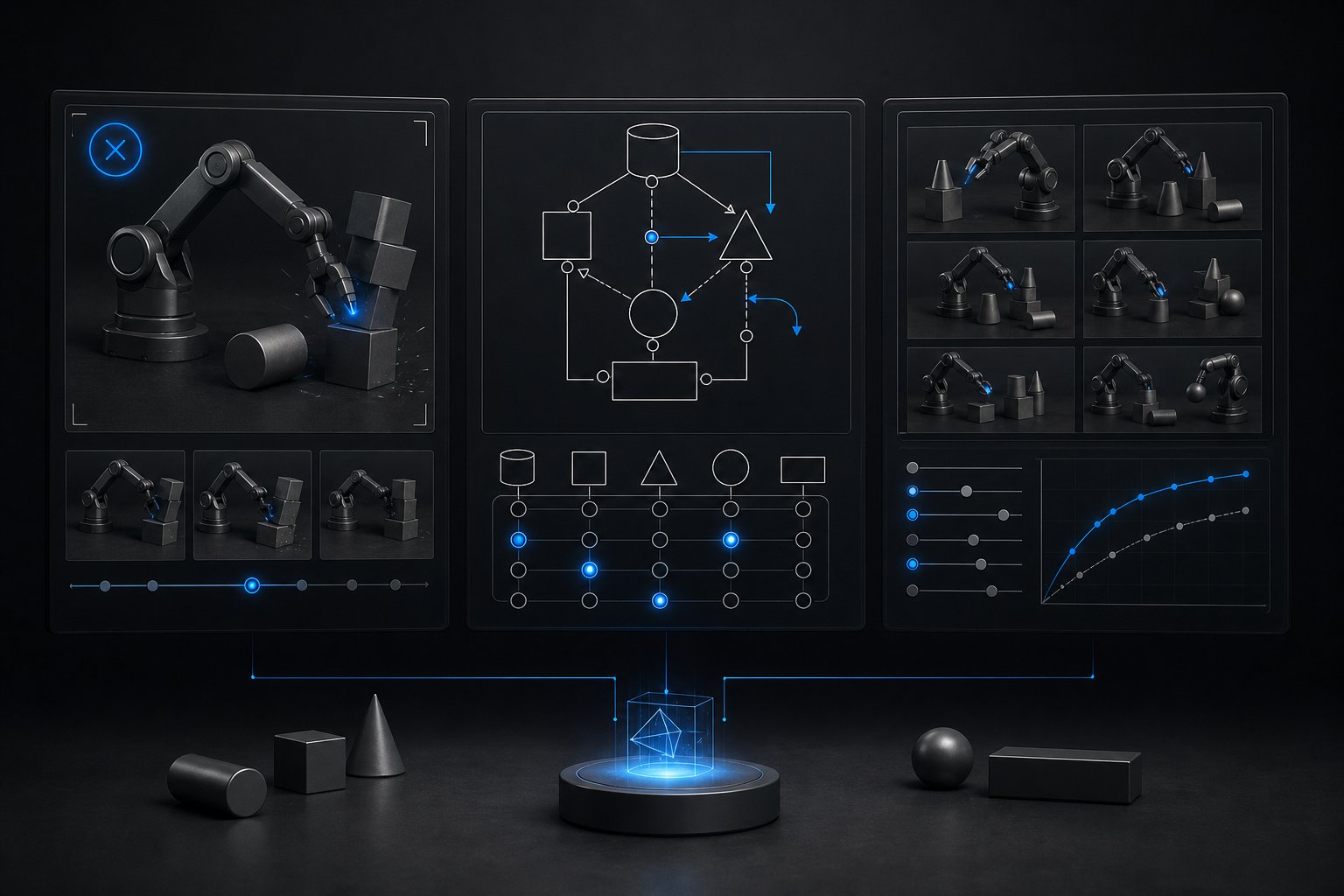
Scale increases exposure; it does not choose the next useful mistake. Observed Curricula studies whether perception and reasoning can aim training pressure more precisely than brute-force data volume.
Premise
Backpropagation remains the weight-update mechanism. The weak point is upstream: data selection, task construction, reward definition, and curriculum order are often crude compared to the cost of training.

Human learning compresses observation into objects, relations, causes, mistakes, and counterfactuals. The machine version is narrower: convert failures into structured practice.
The loop:
- observe unstructured traces,
- extract measurable structure,
- generate targeted tasks,
- train on the generated curriculum,
- measure sample efficiency and transfer.
This is not a claim of novelty around LLM-guided reinforcement learning. The ArX angle is a visual-production loop where failures become controllable synthetic scenes with known geometry, materials, lighting, camera, and task parameters.
Why It Matters
Current training pipelines often treat experience as a volume problem: more tokens, frames, trajectories, and compute. That works, but it wastes attention on data that does not address the active failure mode.

A curriculum-aware system should isolate the error. If an agent confuses occlusion with disappearance, the next batch should contain controlled occlusion cases, not another random mixture of scenes.
Useful intervention points:
- Data: generate labeled examples from observed structure.
- Environment: create synthetic scenes that isolate one skill.
- Curriculum: sequence primitives before compounds.
- Reward: convert subgoals into measurable signals.
- Optimization: adjust sampling weights, loss weights, or fine-tuning targets.
The non-goal is “AI teaches AI” mysticism. The project only matters if the reasoning layer produces verifiable training pressure.
Failure classes worth testing early:
- occlusion versus disappearance,
- contact/support confusion,
- reflective object misclassification,
- tool-use sequencing failure,
- overfitting to simulator lighting or camera priors.
How It Works
A VLM ingests rendered scenes, gameplay traces, robotics demonstrations, or failure logs. It converts them into structured descriptors:

- scene graph: objects, positions, materials, containment, contact,
- action graph: motion, tool use, cause-effect transitions,
- affordance map: movable, openable, stackable, blockable, breakable,
- failure taxonomy: attempted action, failed condition, changed variable,
- task parameters: difficulty, distractors, constraints, success criteria.
A reasoning model turns descriptors into testable curriculum decisions. It does not edit weights directly.
Example interventions:
- generate 500 scenes with partial occlusion and moving distractors,
- increase sampling weight for reflective-object failures,
- add auxiliary labels for support and contact,
- split a compound task into three subgoals,
- create held-out counterfactual scenes to detect shortcut learning.
Closed loop:
- Train a small model or agent on a baseline curriculum.
- Record failures.
- Structure failures with VLMs and simulator state.
- Propose the next curriculum.
- Retrain with the intervention.
- Compare against fixed, random, and human-designed curricula.
The hard constraint is grounding. VLM descriptions can hallucinate. Extracted structure must be checked against object confidence, temporal consistency, simulator state, physics constraints, human review, or task success metrics.
Next
Build a minimal ArX proof in a controlled environment, not a frontier-scale model.
First proof: a MiniGrid-style simulator with ground-truth state, controlled occlusion, distractors, locked doors, and object-goal dependencies. The baseline uses a fixed curriculum. The experimental run updates curriculum after each failure batch.
Success criteria:
- fewer samples to reach the same score,
- better transfer to held-out layouts,
- lower recurrence of identified failure modes,
- no collapse into benchmark-specific tricks.
If sample efficiency improves without transfer loss, move to ArX-controlled 3D scenes: geometry, materials, lighting, camera, and distractor variation.
Generation Prompts
thumbnail AI curriculum-learning command interface, three synchronized panels showing occluded agent failure frames, extracted scene graph with contact edges and action arrows, generated synthetic practice scenes with parameter sliders and sample-efficiency curve, matte graphite surfaces, restrained cyan accents, hyper-real studio interface lighting, crisp white-line diagrams, 3:2 composition, high contrast card-scale readability
error-isolation controlled occlusion experiment scene, small grid-world agent facing a hidden object behind sliding panels, adjacent synthetic variants isolate distractors, lighting, material reflectance, and object permanence, annotated with minimal failure markers and sampling weights, matte black base, pale neutral geometry, single cyan highlight channel, clean technical lighting, sharp isometric view
failure-loop closed-loop training pipeline diagram embodied as a circular machine, unstructured traces entering one side, structured descriptors, targeted synthetic tasks, retraining, and measurable transfer metrics flowing around the ring, modular glass-and-matte-metal components, blue signal paths, parametric precision, dark neutral background, studio-lit hyper-real render, orthographic three-quarter view
scene-graph vision-language reasoning mechanism visualized as a transparent cutaway cube, rendered objects inside connected by scene-graph nodes for support, containment, contact, affordance, and action transitions, failure labels routed into curriculum proposal modules, precise white vector overlays, dark graphite housing, muted blue data threads, hyper-real studio lighting, macro technical detail