Animal Language Interpretability
A cat-specific perception layer can convert movement, posture, sound, location, and routine context into confidence-scored behavior signals for care, enrichment, and early anomaly awareness.
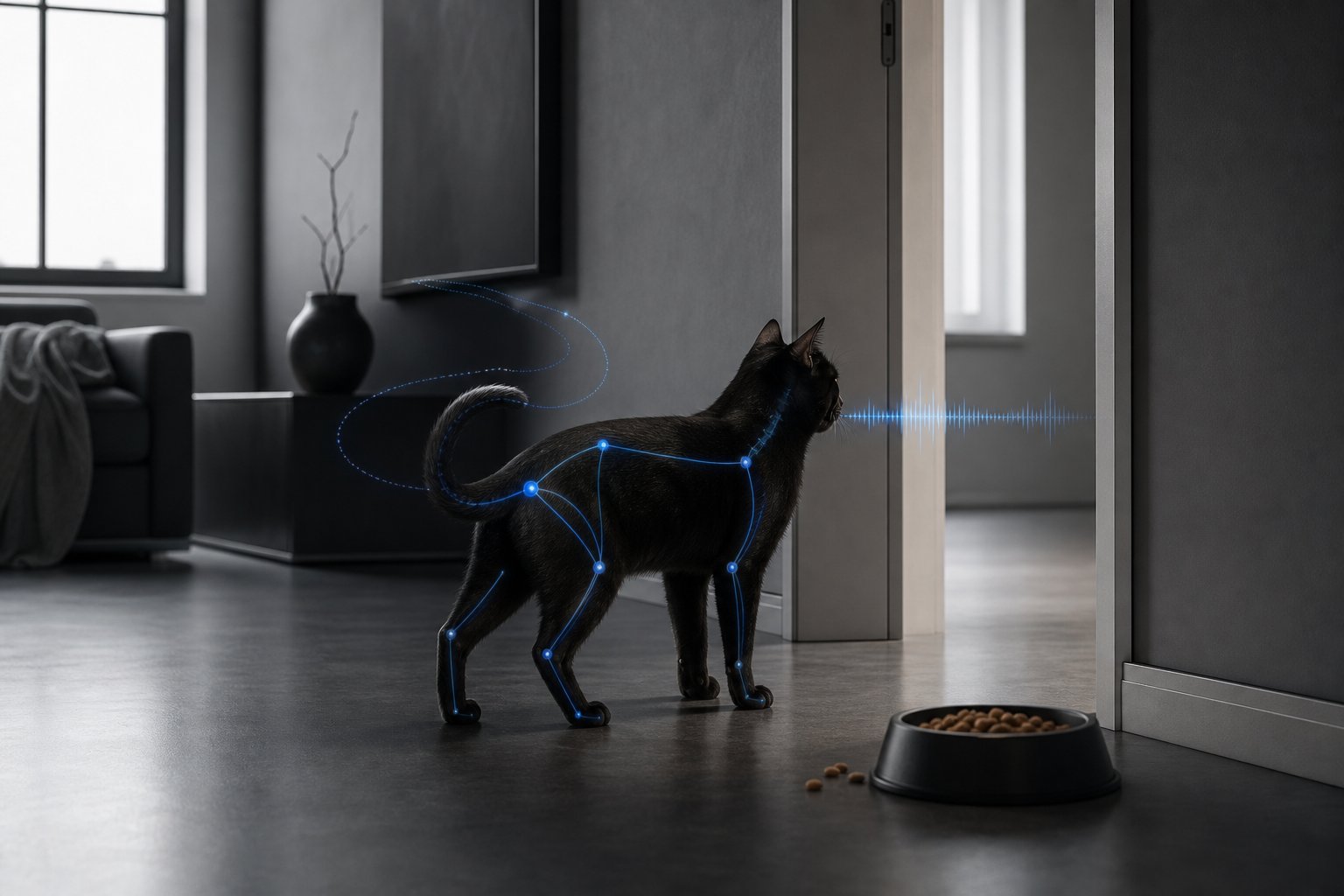
Pet care already depends on pattern recognition: posture, repetition, timing, sound, and context. This project formalizes that reading into evidence-linked behavior signals, without claiming access to an animal’s private inner state.
Premise
Animal communication is not a hidden language. It is embodied signal under context.
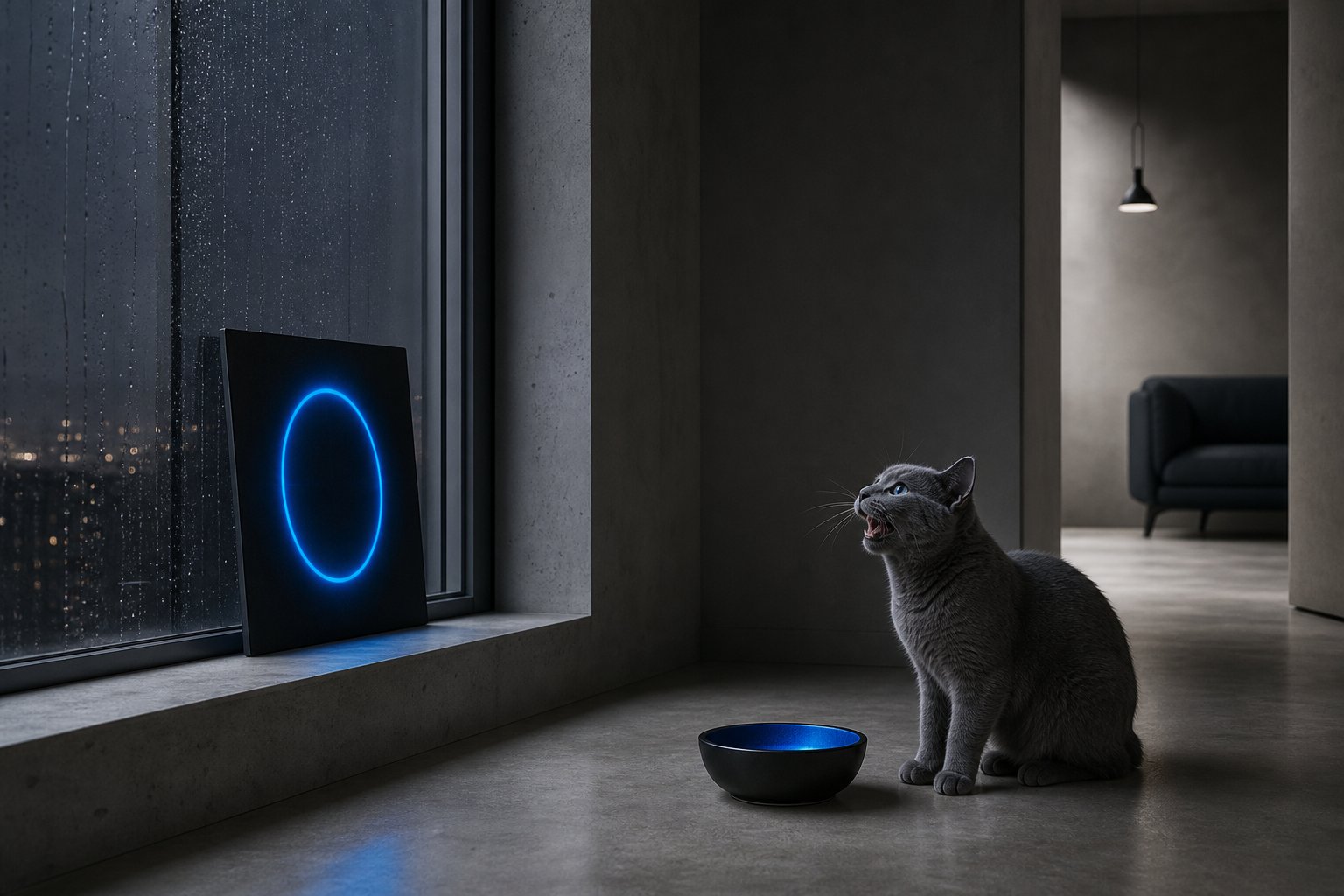
A cat sitting by a bowl while vocalizing before feeding time is not the same event as a cat vocalizing at a window after seeing movement outside. The useful signal is not the frame, sound, or label in isolation. It is the sequence.
The first proof is narrow: single-cat indoor homes, owner-submitted clips, common behaviors, and confidence-scored outputs. Observable behavior comes first. Intent is inferred only when context supports it.
Core distinction:
- Observable: grooming, hiding, eating, pawing a door, tail flicking, litter-box use.
- Contextual: time since feeding, owner presence, room location, visitor arrival, object proximity.
- Inferred: likely food-seeking, possible stress, play solicitation, attention-seeking, discomfort.
Failure mode: novelty pet translator. Useful mode: every inference links back to visible, audible, temporal, and contextual evidence.
Why It Matters
Owners notice behavior; they do not keep clean longitudinal records. Changes in activity, hiding, vocalization, appetite, or litter-box rhythm often become visible only after the pattern is already obvious.
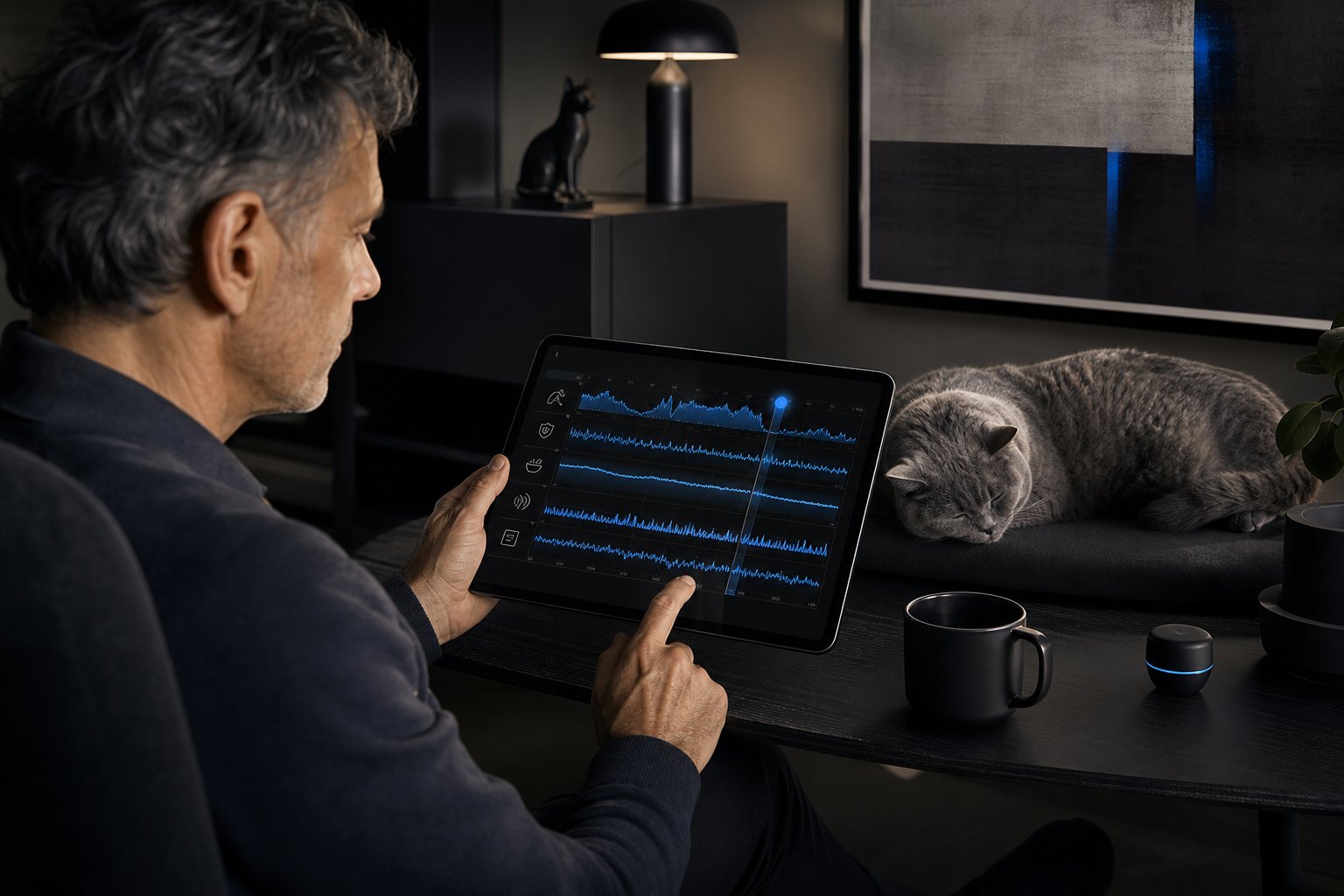
A structured behavior layer could support:
- earlier awareness of unusual inactivity or stress patterns;
- better enrichment through play, feeding, and routine adjustment;
- cleaner communication between owners and veterinarians;
- long-term behavior timelines instead of isolated anecdotes.
Boundary one: this is not veterinary diagnosis. It can flag “different from baseline” or “possible discomfort,” but it should not claim clinical certainty. A veterinarian or feline behaviorist should review the label ontology before any health-adjacent inference is exposed to users.
Boundary two: species specificity. A cat model should not be generalized to dogs, birds, rabbits, or livestock. Each species has its own body grammar, sound set, and environmental relationship.
How It Works
The system begins as passive perception through phone clips or home cameras.
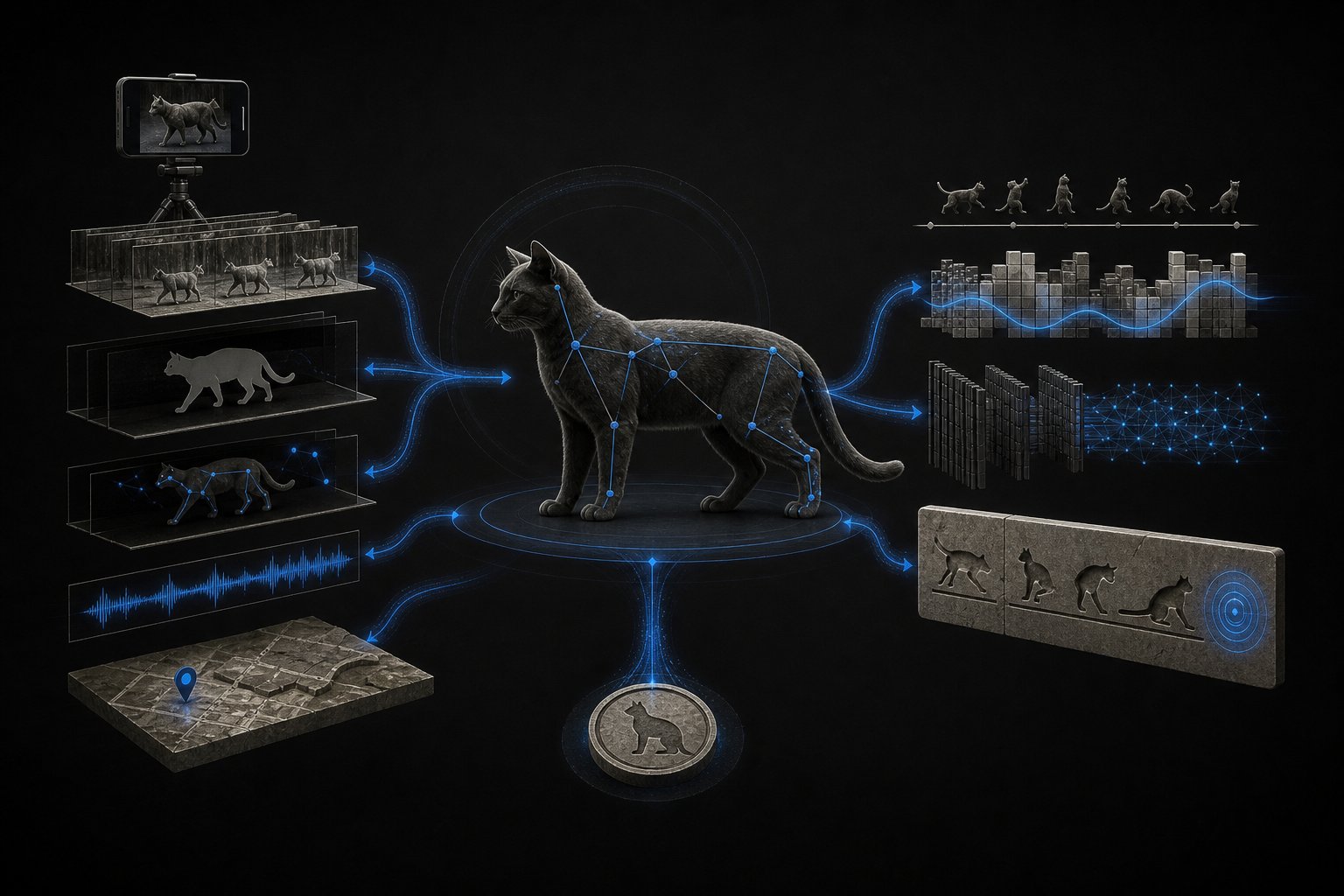
Pipeline:
- ingest short video with synchronized audio;
- segment the cat from furniture, humans, and background motion;
- estimate pose landmarks where possible: head, spine, legs, tail base, tail tip;
- extract motion features: crouch height, stillness, gait change, tail speed, head orientation;
- classify audio events: meow, chirp, hiss, growl, purr-like vibration, distress vocalization;
- attach context: time, room, bowl proximity, litter-box proximity, door proximity, owner label;
- run a temporal model over sequences;
- output behavior state, confidence, supporting evidence, and uncertainty.
The ontology matters more than the model architecture. Owners can label events; the ontology must separate measurement from interpretation. A clip should not simply say “hungry.” It should say: “near bowl,” “repeated vocalization,” “before scheduled feeding,” then infer “likely food-seeking.”
Known weak cases: black cats in low light, occlusion under furniture, reflective eyes, multi-cat homes, camera angle drift, collar or bell audio, background TV contamination, false litter-box detection, privacy concerns, and owner label noise.
The robot is not the invention. It is a later sensor platform. Mobility adds safety, noise, charging, navigation, and pet-acceptance constraints before it adds value.
Next
Build a small cat-behavior dataset before designing a product.
Proof target:
- 500–1,000 labeled clips from 30–50 single-cat homes;
- varied coat colors, lighting conditions, rooms, and camera angles;
- 8–12 common indoor cat behaviors;
- owner-confirmed context labels;
- held-out homes, not merely held-out clips from the same rooms;
- benchmark observable behavior recognition before intent interpretation.
Initial classes: grooming, eating, drinking, litter-box visit, hiding, sleeping, play, door-seeking, bowl-seeking, vocalizing, stress/aggression posture, and abnormal inactivity.
Baseline: compare against owner-only daily recall and simple motion/activity detection before claiming intent value.
The next prototype is a review interface: upload clip, auto-segment cat, suggest behavior labels, let the owner correct them, then generate a daily behavior timeline. If observable states hold across homes, intent becomes a second layer.
Generation Prompts
thumbnail single black cat in a calm modern apartment near food bowl and doorway, translucent perception overlays showing pose skeleton, tail trace, meow waveform, confidence-scored behavior card and daily timeline, matte graphite interior with restrained blue interface accents, soft daylight and studio-grade realism, cinematic 3:2 composition, hyper-real detail
pipeline-view exploded visual pipeline from phone video to cat segmentation, pose landmarks, audio classification, location context, temporal model, and evidence-linked behavior output, modular panels floating around a centered feline silhouette, parametric precision, matte off-black and stone neutrals with blue signal paths, clean technical lighting, ultra-detailed infographic render
signal-context cat vocalizing beside a bowl while a window and doorway sit in the same frame, visual comparison of observable posture, contextual room tags, and inferred food-seeking signal, clean annotated layers separated by thin blue lines, matte neutral apartment materials, soft directional light, realistic camera perspective, high-resolution editorial render
timeline-alerts owner reviewing a tablet dashboard beside a resting cat, longitudinal behavior timeline showing activity, hiding, appetite, vocalization, and litter-box rhythm with one subtle anomaly highlighted, premium minimal interface in graphite and muted blue, warm home setting, shallow depth of field, hyper-real studio-lit documentary style