ARV Sapiens
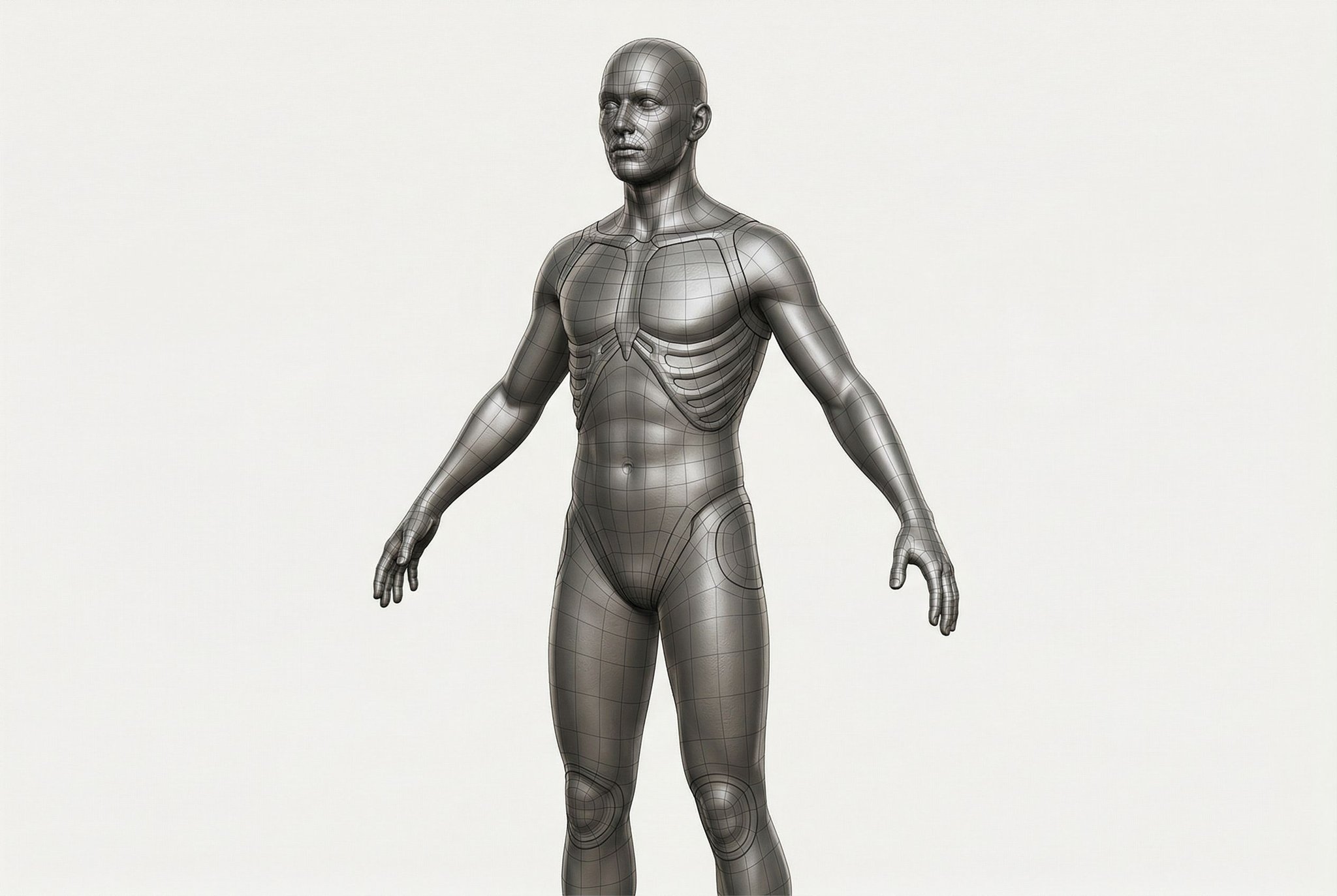
A default-human basemesh system can be built by reconstructing a David-derived anatomical canon into a reusable layered asset for character production, with derived variants for AR/VR presentation.
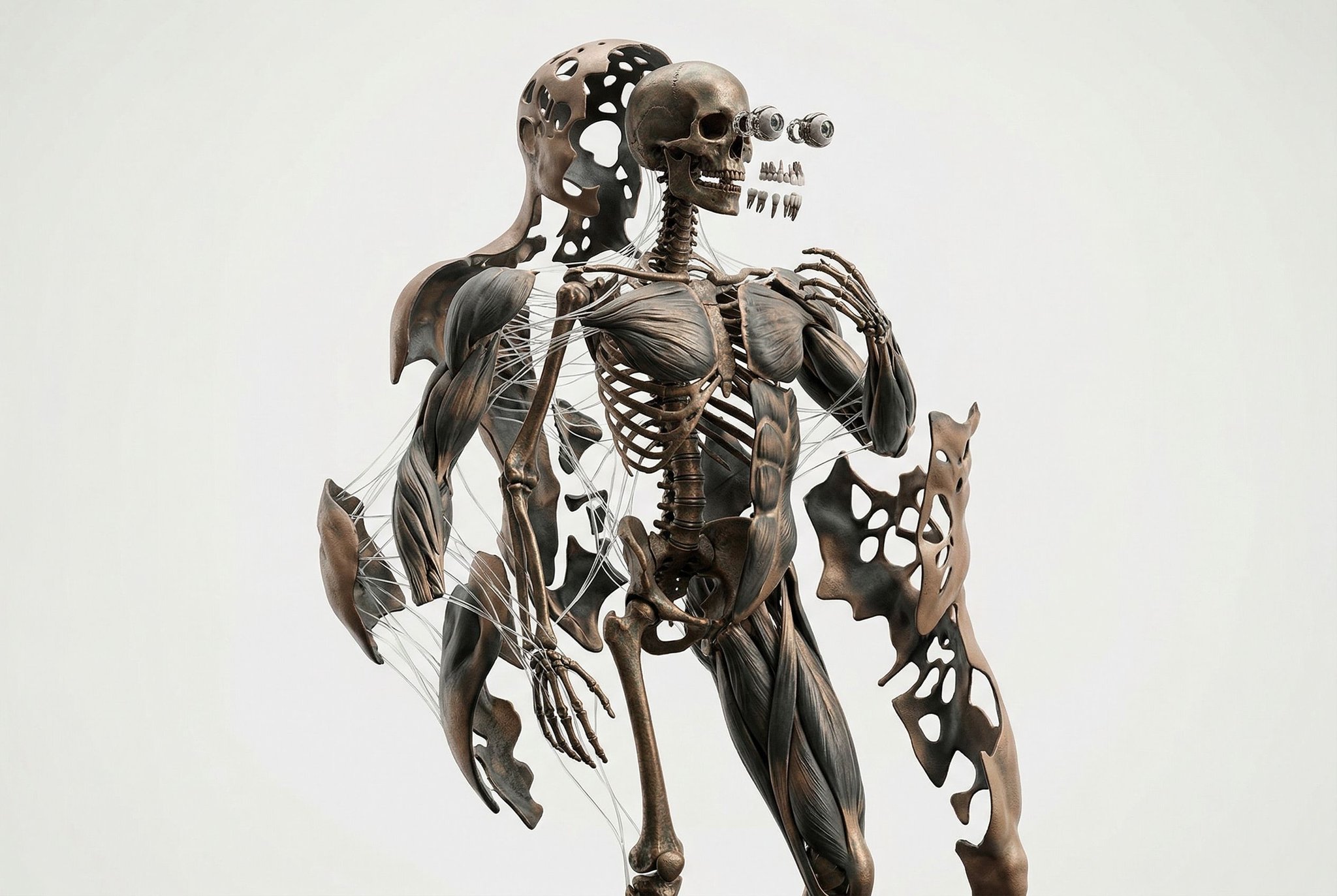
Most humanoid basemeshes are either anatomically noisy, structurally generic, or optimized for one narrow use case.
Premise
- Character workflows repeatedly rebuild the same default human.
- Off-the-shelf scan stores provide data, but not always strong form logic.
- The goal is a canonical humanoid asset that functions as infrastructure, not just a model.
Mechanism
- Canonical Body
- Use David-like proportion as the starting anchor, then rebuild it with clearer landmarks and stronger primary forms.
- David should function as a proportional anchor, not an unquestioned ideal; the system must remain adjustable enough to support later anatomical variation.
- Scan-derived information should inform landmarks, but reconstructed primary forms must override scan noise wherever clarity and reuse demand it.
- Asset Stack
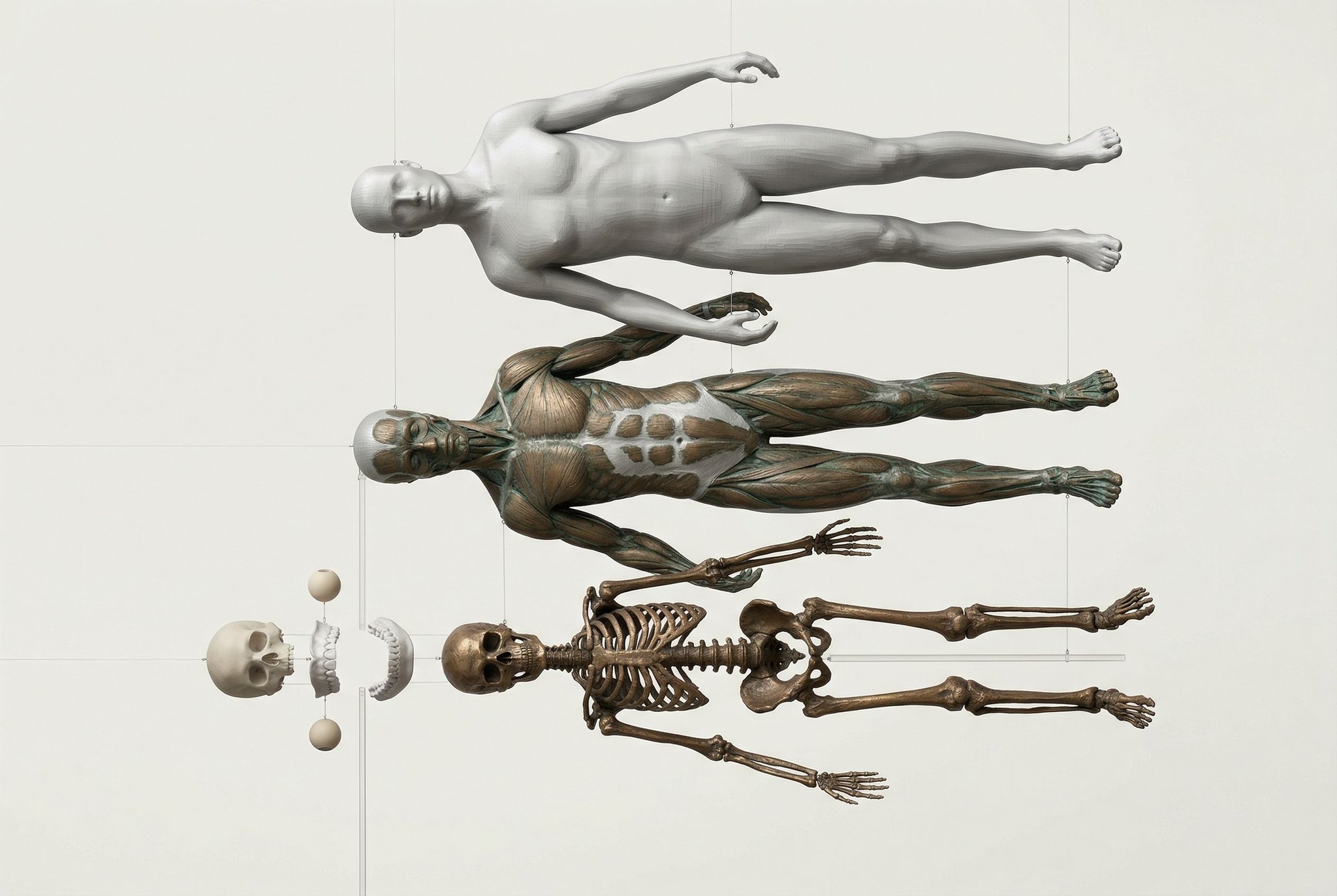
- Neutral outer body
- Skeletal layer
- Muscular or ecorché layer
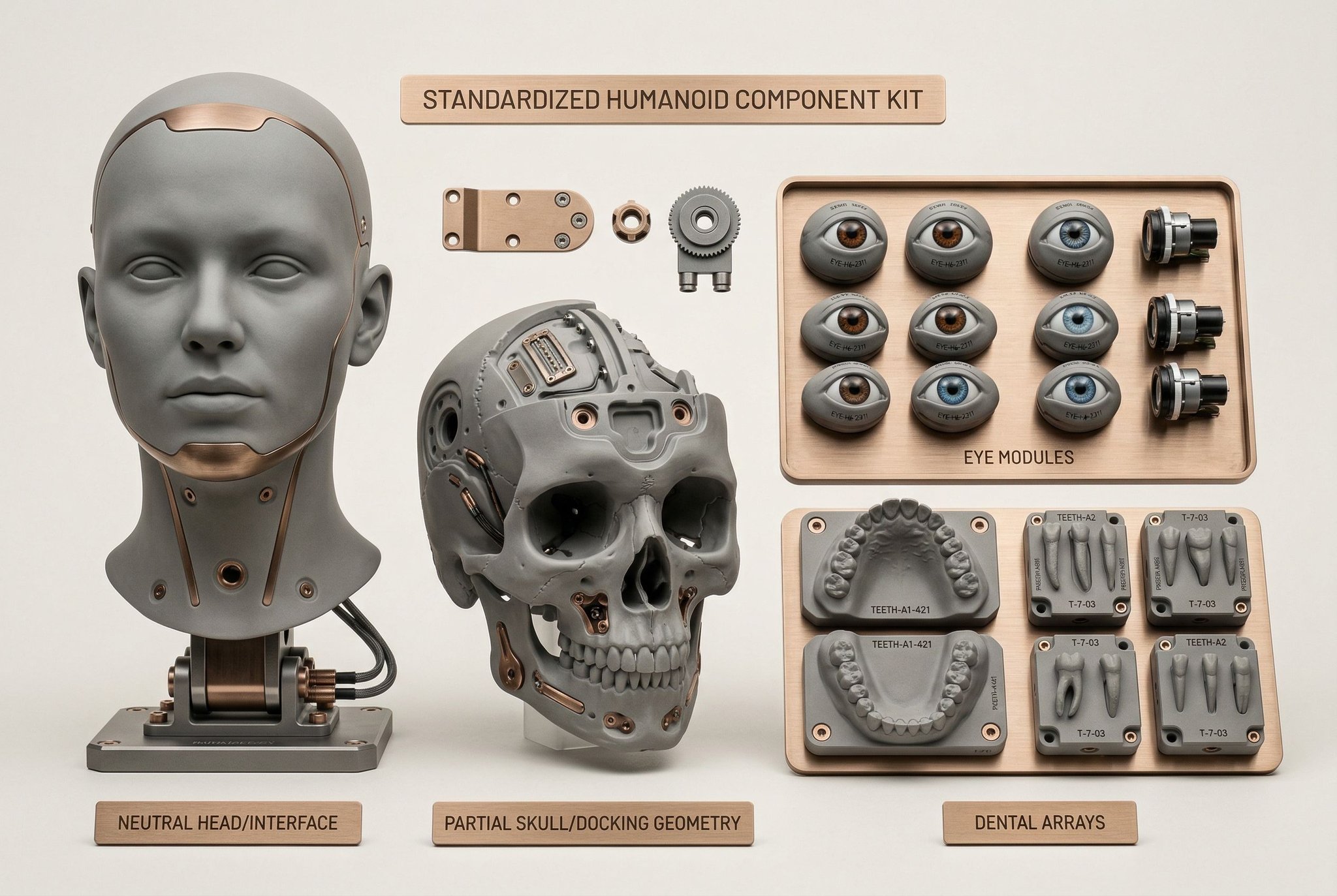
- Standardized eyes
- Standardized teeth
- Optional exploded anatomy views
- Topology Logic
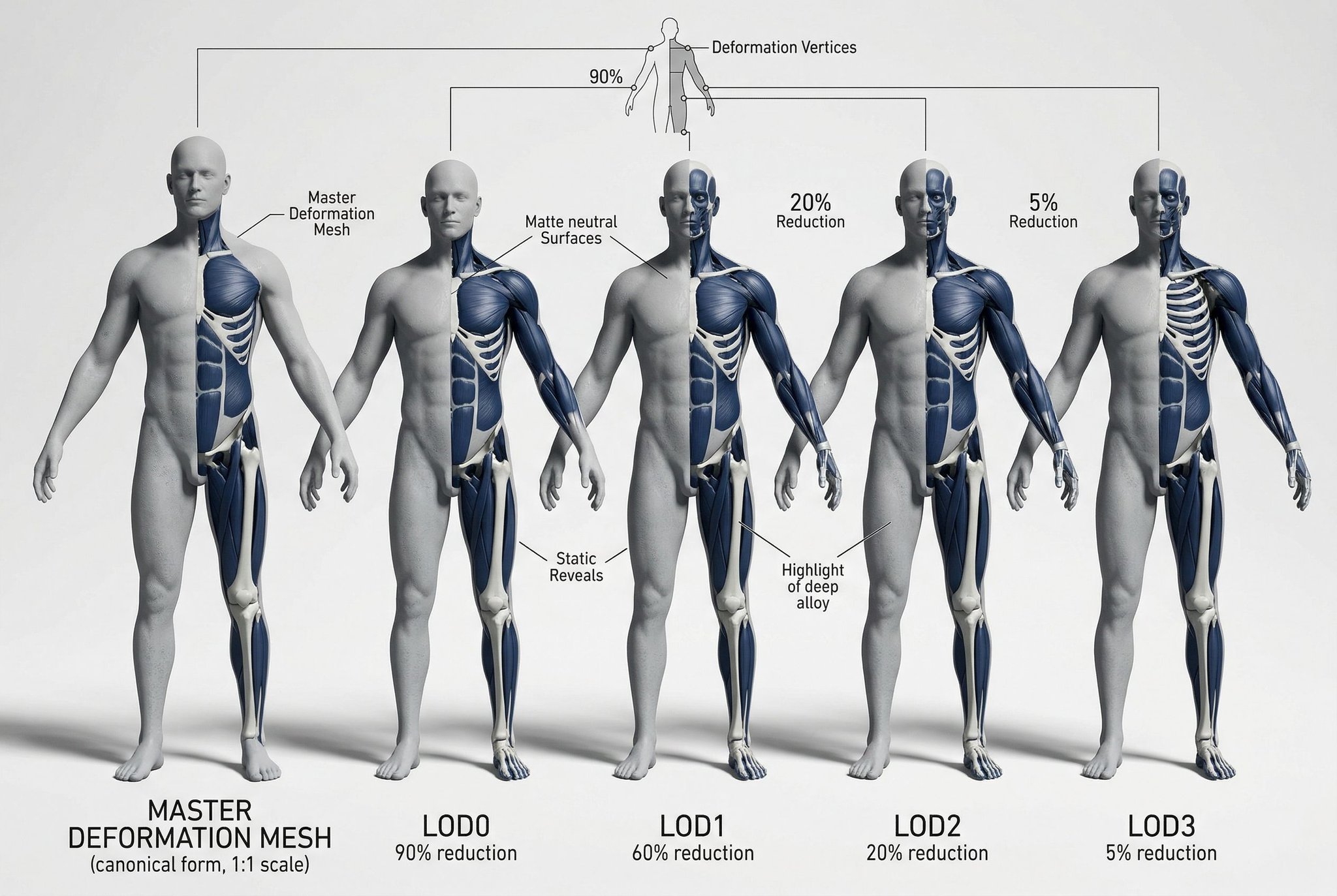
- The master mesh should be deformation-first; runtime variants should be derived as controlled LODs rather than compromising the core topology.
- Layers should share one form logic but remain separable meshes so production, study, and runtime variants can be exported at different complexity levels.
- Presentation System
- One master Blender scene with reusable lighting, camera presets, reveal modes, and turntable logic.
Why This Matters
- It fills the gap between noisy scan-store assets and generic sculpt bases.
- Standardized eyes and teeth matter because they are repeated precision components that otherwise get rebuilt inconsistently across projects.
- One asset can support:
- character concept and sculpt base
- anatomy study
- AR/VR presentation
- internal Arvolve humanoid standard
- eventual commercial basemesh pack
Design Rules
- Better primary shapes than scan noise
- Anatomical clarity without medical clutter
- Eyes and teeth treated as reusable precision components
- Runtime variants built deliberately, not as afterthought decimations
- One scene language reused for all future humanoids
- Material strategy should stay portable: neutral shader baselines for DCC, simplified overrides for runtime, and consistent naming across layers.
What Must Be Proven
- Topology cleanliness
- Proportional consistency
- Anatomical readability
- Rig compatibility
- Runtime performance
- Scene reusability
- Commercial differentiation versus existing basemesh libraries
Execution Path
- Phase 1
- Build the canonical neutral adult system.
- Phase 2
- Derive anatomical variants first, then build heroic and stylized branches as deliberate departures from the canonical system.
- Phase 3
- Turn the family into a modular humanoid library with shared presentation templates.
Trade-offs
- More useful than a static art piece, but less visually indulgent than a pure showcase sculpt.
- More refined than a scan-store asset, but more labor-intensive to maintain.
- 2D presentation benefits from added detail; AR/VR use punishes it.
- The asset succeeds only if the same form logic survives sculpting, deformation, and runtime export.
Strategic Edge
- The real product is not only the basemesh.
- It is the default-human standard: proportion, topology, anatomy layers, and presentation logic unified in one system.
- The internal production standard should precede marketplace packaging; sale is a derivative benefit, not the primary design driver.
Generation Prompts
Image Prompt A premium anatomical basemesh presentation in a dark cinematic Blender studio, classical David-inspired neutral humanoid with separable skin, muscle, and skeleton shells, modular eye and teeth kits docked as reusable components, rig-ready topology visible over idealized forms, subtle exploded anatomy arrangement, reusable presentation templates with visible layer labels, variant placeholders, and scene-control cues, matte neutral materials with deep blue and bronze accents, ultra-detailed high-resolution character-pipeline aesthetic.
Video Prompt Slow cinematic orbit around a David-inspired humanoid basemesh as skin, muscle, and skeletal shells separate cleanly while reusable eye and teeth kits snap into place, rig-ready topology lines and AR-ready overlays appearing briefly, dark premium studio atmosphere, sharp volumetric light, restrained technical motion graphics.
Constraints & Non-Goals
- -The final asset must improve on raw scan-store basemeshes through stronger primary forms and production-grade topology.
- -Anatomical truth matters, but the system must stay optimized for clarity, reuse, and runtime efficiency rather than medical simulation.
- -The first version should prioritize one canonical neutral adult body before branching into demographic or stylized variants.
- -Commercial viability is secondary in phase one; sellability should emerge from system quality, not drive it.
Feasibility Gradient
The project is highly feasible with current character-production workflows. Scan acquisition, sculpt refinement, retopology, anatomical layering, texturing, rig-readiness, and AR/VR export are all standard tasks. The challenge is not technical novelty but product discipline: the asset must avoid becoming too generic for basemesh work, too heavy for runtime, or too simplified for anatomy reference. The strongest near-term version is a proportionally strong neutral humanoid with clean topology, layered anatomy, standardized eyes and teeth, and a reusable Blender presentation scene that doubles as both internal standard and potential product.
Next Actions
- Establish the proportional canon from David plus anatomical reference and define topology density targets for the master mesh and derived runtime LODs.
- Sculpt the idealized outer form, then derive skeleton and ecorché layers from the same form logic.
- Build standardized eye and teeth kits and a master Blender scene with anatomy reveal modes and turntable presets.
- Test the asset for rig compatibility, AR/VR performance, and differentiation against existing scan-store basemesh libraries.
Restricted Layer
The restricted layer would include the full anatomical reference board, topology specification, layer-construction methodology, Blender master scene, AR/VR export rules, commercial packaging plan, and the expansion roadmap into variant body systems.
Request accessLast updated: March 20, 2026