Arvolve Genome
Arvolve’s design language can be systematically captured through a curated, recursively expanding corpus of landmark subjects that becomes the substrate for prompt, image, and 3D generation.

A design language is powerful when it is implicit, and fragile when only one mind can reliably hold it.
Premise
- Arvolve’s aesthetic currently lives across instinct, portfolio, and internal doctrine.
- That makes it potent, but difficult to scale, audit, or computationally reuse.
- The goal is not more outputs. It is a structured aesthetic memory.
- This corpus is not the model itself; it is the provenance-aware canon the model would learn from.
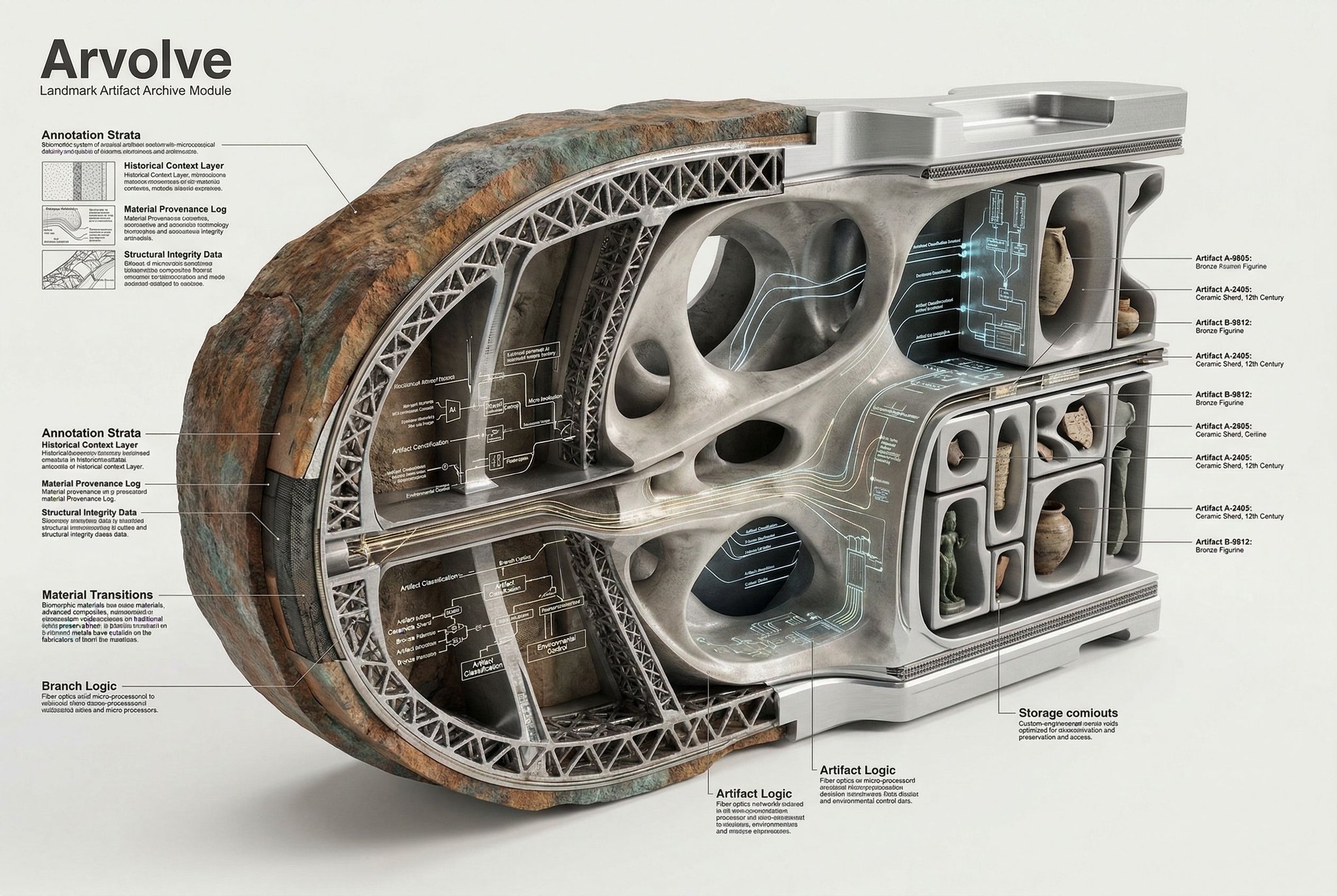
Mechanism
- Canonical Set
- Build the first 100 landmark subjects as the core canon.
- Annotation Layer
- Each entry records subject, style principles, material logic, form language, composition, motion, and narrative intent.
- Interview Extraction
- Founder interviews and company documents are converted into structured theme JSON containing subject, function, emotional tone, material logic, motion cues, composition rules, and allowed branch axes.
- Production Pipeline
- JSON themes feed prompt generation, 2D concept outputs, and then 3D asset generation.
- Recursive Branching
- Each landmark expands into adjacent variants only if lineage, diversity, and style fidelity remain measurable.

Why The First 100 Matter
- They are not examples. They are anchors.
- A weak canon poisons every later branch.
- Selection should maximize aesthetic span, not commercial familiarity.
- The canon should span intimate objects, monumental systems, static artifacts, and kinetic machines.
- The first set must cover divergent subject classes without aesthetic dilution:
- vehicles
- architecture
- devices
- tools
- organisms
- monuments
- systems

What A Landmark Contains
- Subject and theme
- Why it belongs in the canon
- Activated aesthetic invariants
- Prompt scaffold
- 2D concept lineage
- 3D form lineage
- Branch rules and provenance trail
- Example:
subject: ceremonial rover | invariants: kinetic silhouette, mineral-metallic skin, engineered voids | branch axes: scale, material, function, era
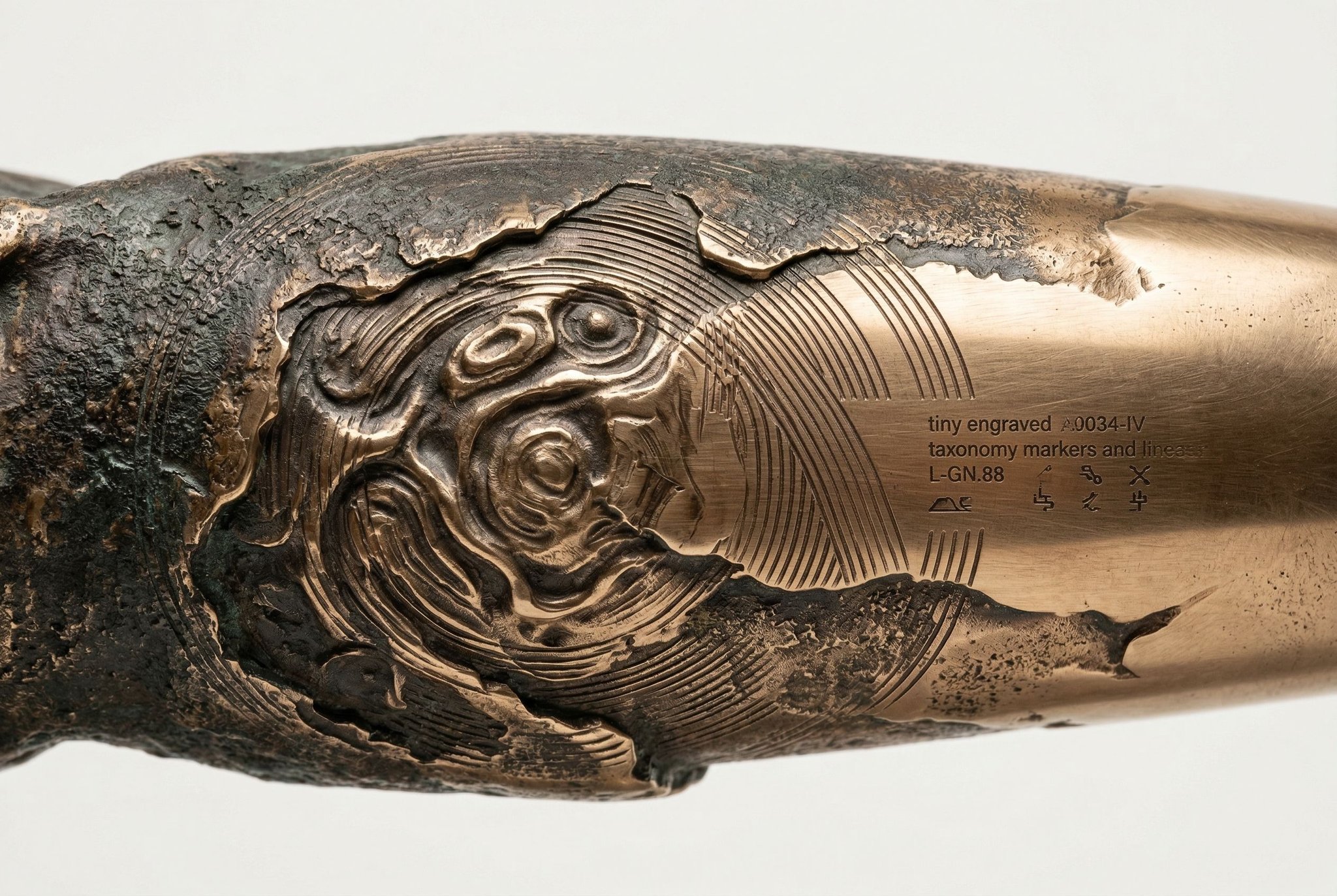
Evaluation
- Style fidelity
- Subject coverage across the canon
- Novelty without drift
- 2D-to-3D consistency
- Lineage clarity
- Canon gap analysis
- Style fidelity should be scored through a hybrid review loop: model pre-screening followed by human curator approval.
- Branches below threshold are pruned rather than recycled into further expansion.
Trade-offs
- More scalable than founder intuition alone, but vulnerable to aesthetic drift.
- Richer than a style moodboard, but heavier to build and maintain.
- Synthetic abundance can create false confidence; weak descendants can outnumber strong anchors.
- Interviews reveal explicit taste, but actual works may encode deeper truths the founder does not verbalize.
- 2D generation will likely scale faster than 3D; the 3D stage may require constrained generators, retopology, or manual correction to preserve form fidelity.
Strategic Edge
- This is not just a dataset.
- It is the provenance-aware memory architecture of Arvolve’s design intelligence.
- If built correctly, it becomes a bridge from founder taste to executable, extensible, and eventually trainable creative infrastructure.
Generation Prompts
Image Prompt A premium research-studio visualization of an aesthetic genome archive, luminous canonical artifacts spanning intimate tools, monumental vehicles, symbolic objects, and kinetic machines, all sharing bio-algorithmic silhouettes, mineral-metallic surfaces, and frozen-turbulence detailing, arranged in a precise taxonomy wall, dark elegant environment, blue-violet semantic glow, ultra-detailed computational curation aesthetic.
Video Prompt Slow cinematic move through a curated design archive as a single canonical artifact with kinetic silhouette and mineral-metallic surface branches into theme nodes, prompt cards, 2D sketches, and polished 3D descendants, lineage lines illuminating across a taxonomy of intimate tools, symbolic objects, monumental systems, and kinetic machines, dark premium studio atmosphere, crisp volumetric light, restrained futuristic motion graphics.
Constraints & Non-Goals
- -This cannot become a brute-force synthetic dataset; the first 100 landmarks must be deeply curated before any scale expansion begins.
- -The corpus must encode principles, subject diversity, and transformation logic rather than only surface style.
- -Recursive branching must remain auditable, with every derivative asset linked back to source themes, prompts, and decisions.
- -External references, licensed material, and inspirational sources must be tagged or excluded to prevent legal and aesthetic contamination of the corpus.
Feasibility Gradient
The pipeline is plausible because its components already exist: structured annotation, prompt systems, image generation, emerging 3D generation, and provenance-aware dataset design. The main difficulty is not production throughput but aesthetic integrity. Recursive scale can quickly generate hollow lookalikes if the first canonical set is weak or the branching rules are too loose. The strongest near-term path is to treat this as dataset architecture: extract style principles from founder interviews and existing works, define a subject taxonomy, build the first 100 landmark entries manually, and only then expand through controlled prompt-to-2D-to-3D loops with strict curation gates.
Next Actions
- Define the first 100 landmark subject categories that best span Arvolve’s full design territory.
- Create the annotation schema for form language, material logic, motion, composition, narrative tone, and functional archetype.
- Build the founder-interview-to-JSON pipeline that feeds prompt generation and branch lineage.
- Prototype controlled expansion from canonical entries into 2D and 3D descendants with style-fidelity scoring, pruning thresholds, and provenance checks.
Restricted Layer
The restricted layer would include the full landmark taxonomy, annotation schema, founder interview extraction pipeline, JSON ontology, branching rules, evaluation system, prompt generation framework, governance rules, and the IP map around provenance-aware aesthetic datasets.
Request accessLast updated: March 20, 2026