Arvolve Style Bible
A small set of annotated landmark assets can act as Arvolve’s design genome, guiding AI generation through controlled branches instead of generic style drift.

Most AI design pipelines produce volume before they preserve identity. The Seed Atlas treats Arvolve’s design language as a curated genetic system: small at the root, annotated with precision, expanded only through selective pressure.
Premise
The project begins with 12–24 landmark assets: original concepts, sculptural studies, product forms, architectural fragments, material boards, character work, interface directions, and symbolic cues that already feel unmistakably Arvolve.

A landmark asset must be original, licensed, or sufficiently abstracted; visually strong at thumbnail scale; reusable beyond one domain; and free from direct dependence on recognizable third-party style.
Each asset is treated less as inspiration than as structured design memory. The annotation layer captures:
- Form: silhouette, proportion, massing, curvature, edge language.
- Material: surface logic, finish, tactility, aging behavior.
- Function: what the object does, what it refuses to do.
- Mood: emotional temperature, restraint, tension, softness.
- Symbolic logic: motifs, cultural references, metaphors, archetypes.
- Constraint: scale, manufacturability, interaction, production path.
- Arvolve fit: why it belongs inside the language.
A minimal record could include asset_id, domain, silhouette_tags, material_logic, exclusions, arvolve_fit_score, and branch_permissions.
The near-term goal is not model training. It is a taste dataset ArX can read, query, remix, and test.
Why It Matters
Generative tools produce plausible images, but they do not preserve authorship by default. Without a controlled reference system, each new branch risks drifting toward platform averages: cinematic grey machines, generic luxury objects, soft sci-fi shells, or over-detailed concept art.
Arvolve needs a compact internal source of truth that can answer one question: does this output belong to us?
The Seed Atlas makes Alin’s design intuition explicit without reducing it to a rigid brand guide. Arvolve’s leverage depends on compounding taste, not isolated outputs. A repeatable language that produces related but non-identical concepts across products, vehicles, tools, environments, and interfaces becomes infrastructure.
How It Works
The pipeline has five controlled layers.

-
Interview to theme JSON
Personal notes, interviews, dislikes, references, production experience, and philosophical constraints become theme JSON: nouns, verbs, materials, proportions, exclusions, emotional targets, and domain fit. -
Landmark annotation
Selected assets are described manually and semi-automatically. The priority is why an asset works, not only what it depicts. -
Prompt generation
ArX converts theme JSON and asset annotations into prompt families: conservative, adjacent, hybrid, and extreme. Each prompt carries inclusions, exclusions, and drift guards. -
2D and 3D branching
2D generation explores composition, silhouette, material direction, and product mood. 3D generation supports massing, kitbash scaffolds, spatial studies, and form discovery, not final production geometry. -
Selection loop
Outputs are scored, pruned, and reintroduced only when they strengthen the language. Weak branches become negative examples.
Evaluation stays strict:
- Recognizable as Arvolve without a logo.
- Traceable to at least one landmark rule or theme constraint.
- Clear mechanism or use-case, not only style.
- Low dependence on trendy AI artifacts.
- Strong silhouette at small scale.
- Material choices that support the object’s function.
- Enough novelty to expand the language, not merely repeat it.
A failed branch is one that looks polished but cannot be traced back to a landmark rule, material constraint, or functional premise.
Next
Build the v0 Seed Atlas with 12–24 landmark assets and one theme schema.
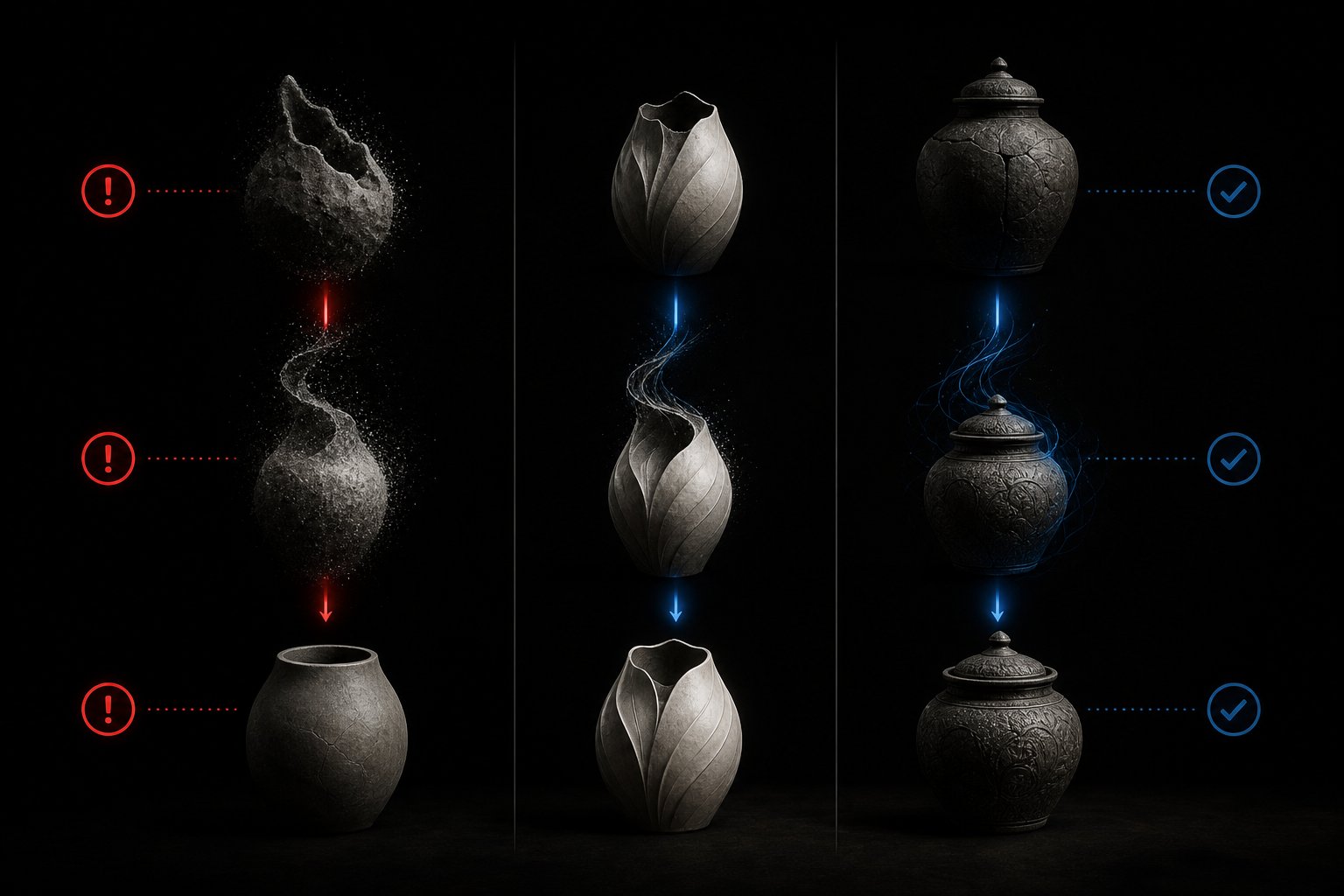
The first proof compares three generation rounds:
- Round A: generic prompt without dataset context.
- Round B: prompt generated from theme JSON.
- Round C: prompt generated from theme JSON plus landmark annotations and exclusions.
Success is not beauty. The benchmark is coherence: can an external reviewer identify Round C as a more consistent Arvolve direction across at least 70% of selected outputs?
If the result holds, document one successful branch as a finished Atlas entry and fold its strongest artifacts back into the dataset as a new sub-lineage.
Generation Prompts
Image Prompt
Dark graphite research interface showing Arvolve’s Seed Atlas: annotated landmark asset cards, JSON theme panels, branching concept thumbnails, sculptural 3D form studies, material swatches, lineage arrows, white micro-typography, restrained warm gold accents, museum-grade lighting, precise high-end design archive aesthetic.