Builder Economy
As AI lowers the cost of producing testable artifacts, economic value shifts from capturing consumer attention to increasing builder output.

Builder Civilization studies a market inversion: infrastructure shifts from maximizing consumption to increasing the output quality of people who make testable artifacts.
Premise
The consumer internet scaled attention. AI-native infrastructure scales agency.

AI coding tools, generative media systems, no-code platforms, automation agents, open-source models, and distributed fabrication compress the distance between idea and prototype. A solo operator can now simulate fragments of a studio, software team, marketing desk, and operations stack.
This does not make everyone an inventor. It lowers the threshold for producing a testable artifact.
Builder means behavior, not job title: converting models, tools, and knowledge into public artifacts. The category includes software, hardware, media, education, local services, and research interfaces. Non-builder: a person who only consumes, comments, curates, or prompts without converting output into a public artifact, service, tool, or tested system.
Early evidence is mixed. AI tools are becoming normal in developer workflows, but Stack Overflow’s 2025 survey shows favorable sentiment falling to roughly 60%. Adoption does not equal trust.
Why It Matters
If builders become a stronger source of economic motion, surrounding markets change shape.
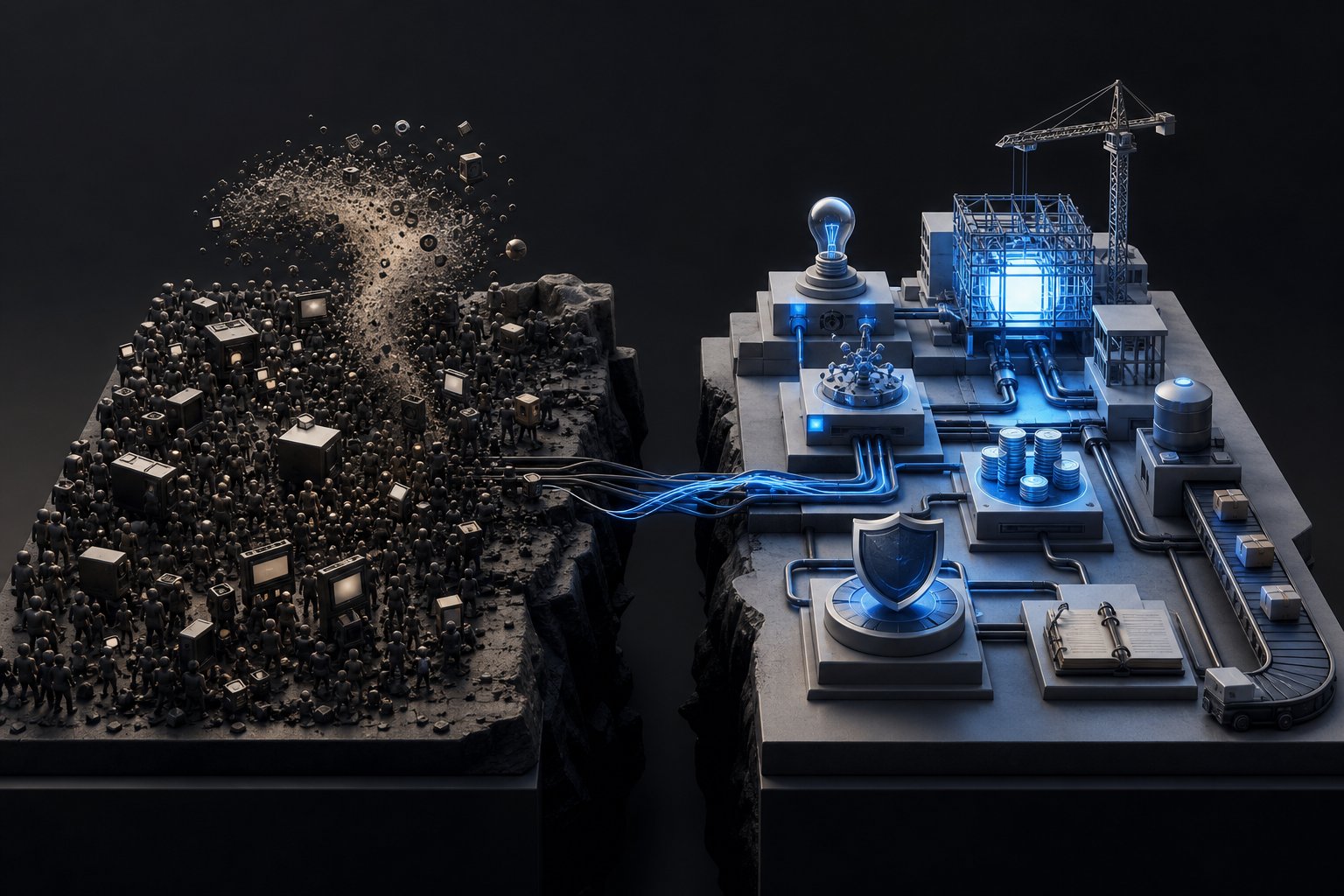
Tools are the obvious layer. The larger market is support infrastructure: focused nutrition, deep-work environments, rapid learning loops, lightweight finance, credibility signals, local fabrication, distribution, and AI collaborators that preserve authorship.
The market question changes.
Not: how do we capture more consumer attention?
But: how do we raise the quality, speed, and survival rate of useful artifacts?
That shift reorders value around capability. Taste, judgment, trust, distribution, capital, and execution become the real bottlenecks. AI expands production capacity, but it does not choose what deserves to exist.
How It Works
Builder civilization emerges through compounding infrastructure.
-
Capability compression
AI reduces the cost of code, visuals, writing, research, interface design, and automation. The solo operator gains partial-team leverage, not full institutional replacement. -
Prototype acceleration
Ideas can be tested as landing pages, scripts, mockups, 3D models, micro-SaaS products, synthetic campaigns, or physical prints before large capital is committed. -
Market specialization
More builders expose daily friction: context switching, poor documentation, scattered tools, weak validation, bad health rhythms, lonely execution, fragile distribution. -
Cultural convergence
Value shifts toward people who can move between concept, system, artifact, and audience. The coder, artist, founder, engineer, educator, and media operator start merging into one hybrid archetype. -
Infrastructure feedback
Better tools create more builders. More builders reveal new bottlenecks. Those bottlenecks become the next product categories.
The failure mode is false abundance: more tools, more drafts, more unfinished work. The missing layer is orientation: what to build, why it matters, how to validate it, and when to stop.
Key constraints:
- distribution saturation makes competent artifacts invisible
- model dependency creates brittle workflows and shifting costs
- IP, attribution, and data provenance remain unresolved
- hardware still hits material, safety, logistics, and certification limits
- income volatility makes sustained building harder than initial prototyping
Next
The next proof is a builder-needs taxonomy.
Segment builders by operating mode:
- software builder
- hardware builder
- artist-founder
- researcher
- educator
- local systems entrepreneur
- automation consultant
- worldbuilder / media designer
For each segment, map one daily friction, one current workaround, one measurable failure, and one product hypothesis.
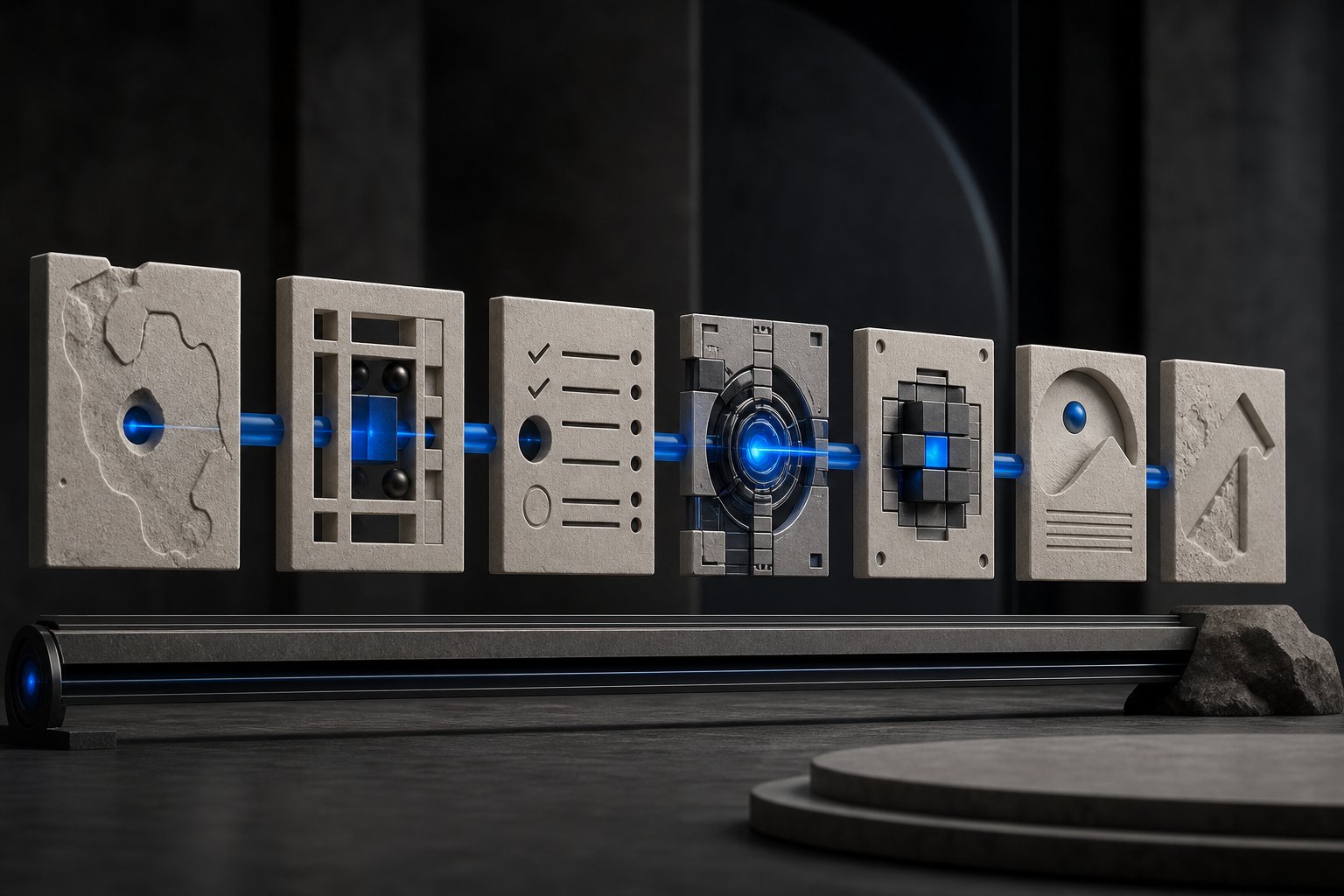
First prototype: a Builder Operating Stack — research template, validation checklist, AI workflow, and artifact pipeline. Constraint: one raw idea to one testable output in under 48 hours.
Benchmark: five builders use the stack on real projects. Success means each produces a public prototype, documented decision trail, and next action without needing a team.
Generation Prompts
thumbnail cinematic overhead view of a compact AI-native builder studio, solo operator centered in a dense decision trail of annotated sketches, code panels, 3D-printed prototypes, electronics breadboards, validation notes, shipping boxes and nutrition tray, premium minimal workspace, graphite neutrals with restrained blue interface glow, warm focused lighting, hyper-real studio detail, 3:2 aspect
artifact-pipeline exploded-view artifact pipeline for a Builder Operating Stack, raw idea card transforming through research template, validation checklist, AI workflow, prototype file, public launch page and documented next action, each stage as a tangible module on a clean rail, parametric precision, matte stone surfaces, blue progress core, neutral studio illumination, hyper-real product diagram
capability-map solo builder workstation shown as a radial capability map, laptop generating code, visual mockups, research summaries, automation flows and fabrication files into separate physical artifacts, clean labels embedded as interface cards, matte graphite desk, brushed metal tools, pale neutral papers, single blue signal path connecting outputs, studio-lit hyper-real render, sharp isometric angle
value-shift split market diagram visualized as two miniature economies, left side crowded attention feeds fading into noise, right side builder infrastructure powering prototypes, finance cards, credibility badges, learning loops and distribution rails, precise architectural composition, matte off-black base with neutral modules and blue active nodes, dramatic side lighting, hyper-real editorial infographic style