Droids of the Future
Future Droid Lineage defines a robot design taxonomy where silhouette, material hierarchy, and proxemic movement make non-humanoid machines feel legible, calm, and physically trustworthy.
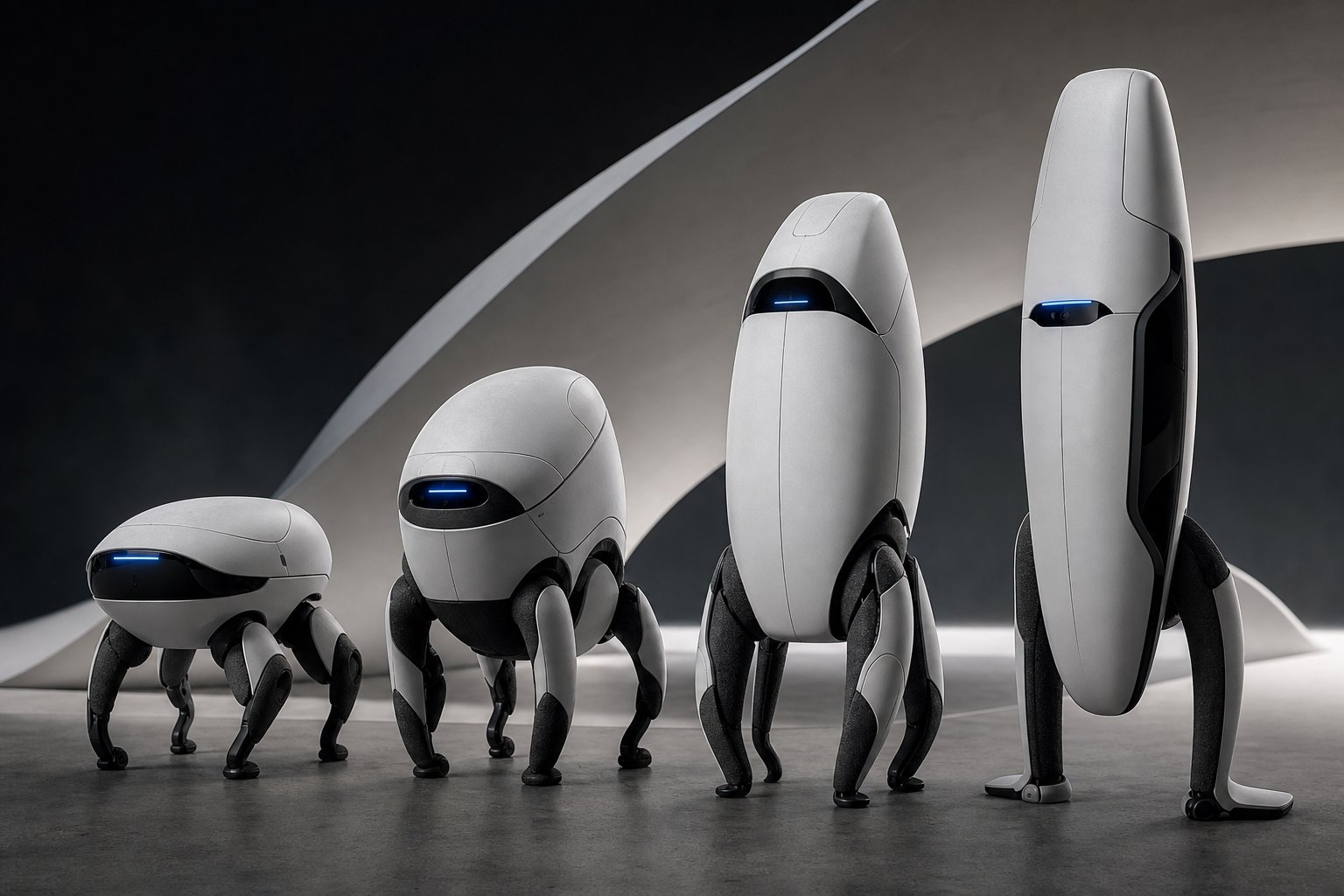
Many robots still expose their engineering before they communicate intent. This project treats the Arvolve robot as a designed lineage: a family of physical agents whose form, motion, and material presence improve without becoming fake people.
Premise
The question is not capability alone. It is presence: how a robot approaches, waits, assists, retreats, and rests without creating visual or social friction.
The avoided patterns are toy, appliance, weapon, and exposed mechanism. Arvolve’s direction is quieter: aerodynamic silhouettes, restrained surface breaks, tactile materials, readable posture, and emotional character without humanoid mimicry.
The lineage is studied across four constrained time bands:
- 2030 — Assisted Objects: compact helpers using existing actuators, limited battery capacity, and choreographed autonomy.
- 2040 — Mobile Companions: quieter locomotion, better manipulation, improved perception, and cleaner social readability.
- 2050 — Adaptive Droids: modular shells, soft robotics, e-skin, lighter structures, and partial body reconfiguration.
- 2060 — Synthetic Species: speculative morphologies with seamless materials, animal-grade movement, and culturally legible robot identity.
The reference base stays hybrid: 20th-century vehicles, early aviation, birds, insects, marine life, prosthetics, and future composites.
Why It Matters
Robots will enter intimate environments before they become elegant. Homes, hospitals, airports, workshops, and creative studios need machines that do not visually exhaust people or force constant threat decoding.
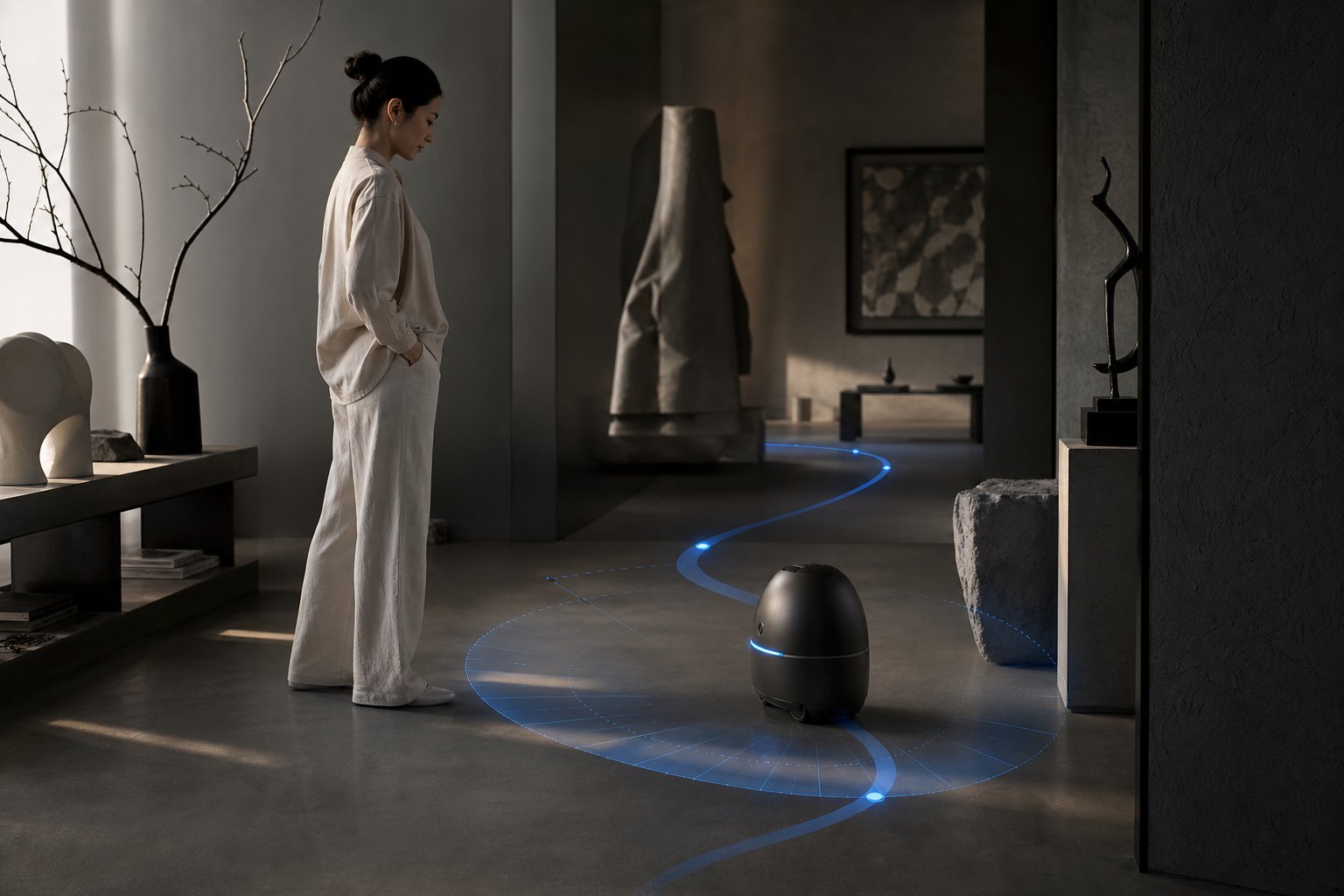
A companion robot does not need a human face to feel present. It needs legible intention:
- where it is looking;
- whether it is approaching, waiting, assisting, or withdrawing;
- what surfaces are safe to touch;
- when it is active, resting, charging, or listening;
- how close it will come before slowing down.
Form can reduce first-contact hesitation. A robot with unclear joints, harsh posture, silent rear entry, or militarized mass asks the human to decode risk before utility. The target is a calm tool with animal-grade readability and vehicle-grade precision.
The ethical limit is explicit: the robot should not simulate personhood, dependency, or emotional reciprocity it cannot sustain. Presence must support human agency, not replace it.
How It Works
The project builds a visual taxonomy rather than a single product. Each decade receives one hero robot and one supporting design sheet.
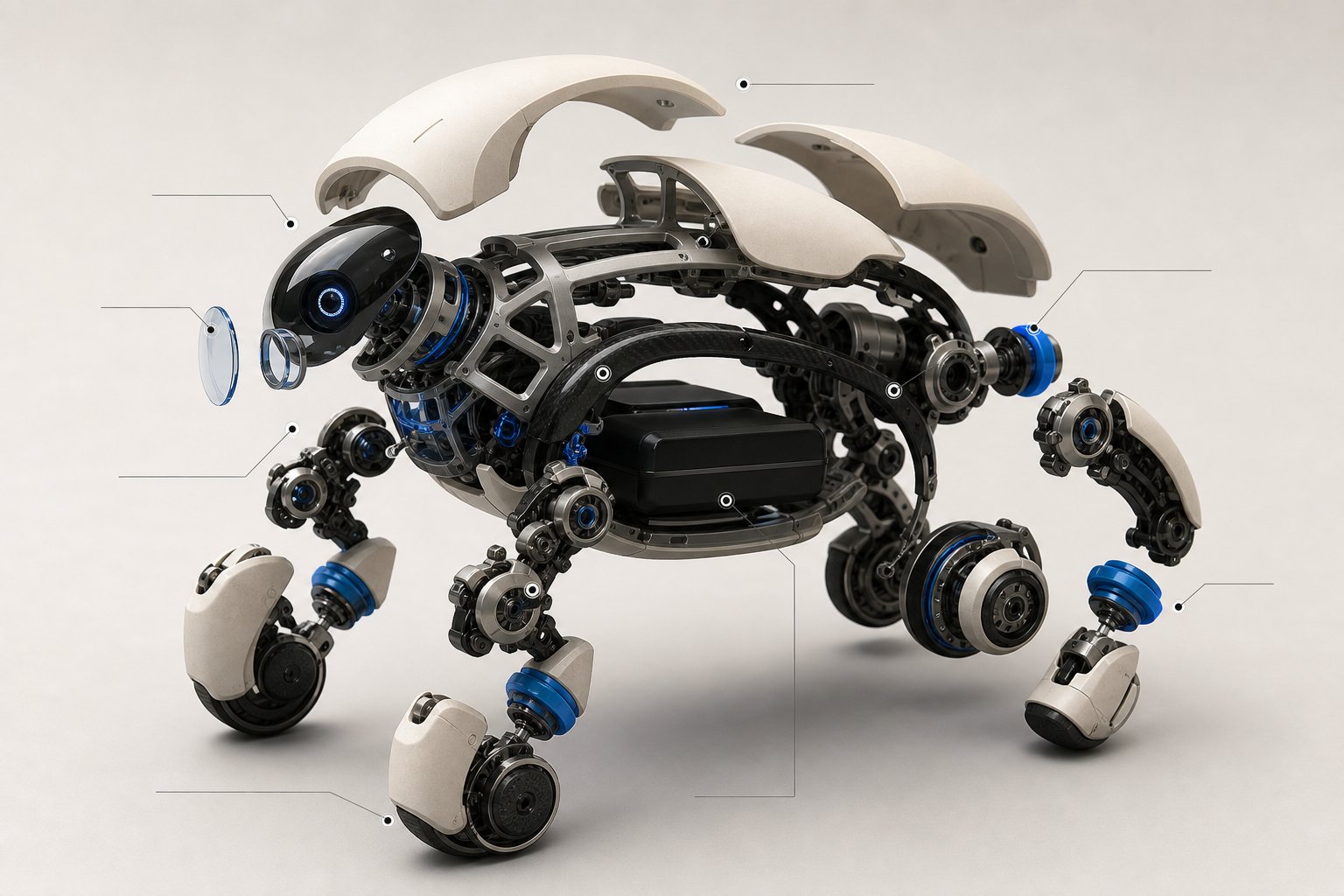
Shared Arvolve DNA:
- Silhouette rhythm: long aerodynamic curves interrupted by precise mechanical anchors.
- Face language: minimal sensor zones, no cartoon eyes, light used for attention and status.
- Limb geometry: visible load paths, protected joints, soft-contact extremities.
- Material hierarchy: ceramic shell, aircraft aluminum, carbon structure, elastomer buffers, translucent interface glass.
- Movement grammar: pause before approach, low-noise turns, head-body offset, soft retreat, visible rest states.
- Proxemic rules: slow approach inside personal distance, visible retreat path, no silent rear entry, predictable passing arcs, clear waiting posture.
- Role archetypes: courier, studio assistant, field scout, domestic companion, medical aide, guardian without weapon language.
The decade model keeps the work grounded. 2030 and 2040 can be expressed through current robotics, industrial design, CGI motion studies, and ArX-assisted visual iteration. 2050 and 2060 remain speculative, but they are constrained by plausible advances in batteries, actuators, soft robotics, embedded AI agents, and adaptive materials.
Non-goal: humanoid replacement. These are designed physical intelligences with their own body language, repair logic, and privacy boundaries.
Next
The next proof is a four-part visual board:
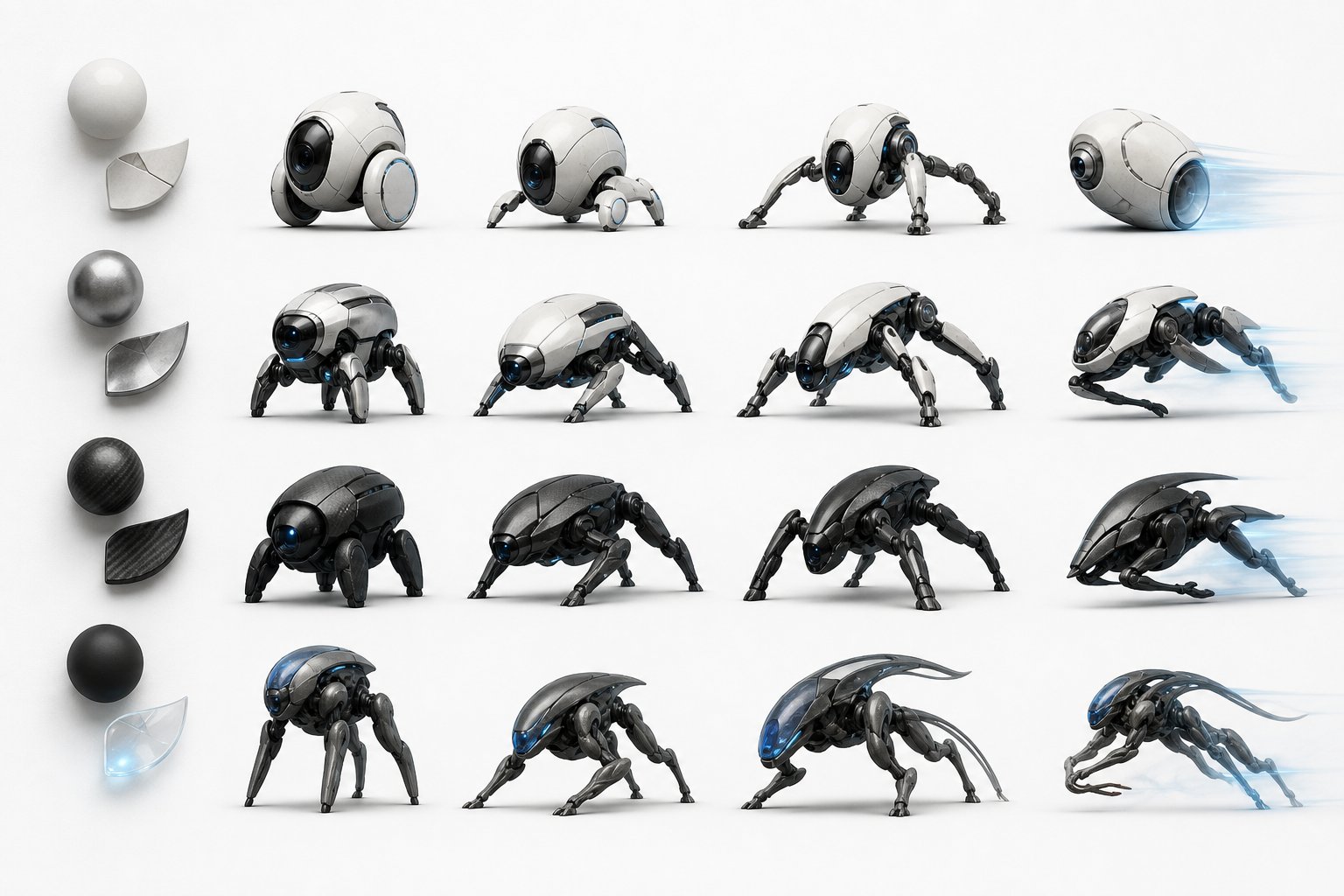
- one hero robot for 2030, 2040, 2050, and 2060;
- front, side, three-quarter, idle, approach, crouch, and charge silhouettes;
- a material strip comparing shell, joint, interface, and touch zones;
- a motion strip showing observe, approach, assist, retreat, rest, and charge.
Success is measured by recognition. If the four robots feel related without looking identical, the lineage works. If the 2060 robot still carries visible ancestry from the 2030 robot, the design language has continuity.
Generation Prompts
thumbnail four non-humanoid companion droids arranged as a future robot lineage from 2030 to 2060, distinct silhouettes sharing aerodynamic ancestry, ceramic shells, carbon joint anchors, soft elastomer touch zones, minimal sensor glass, human scale figure, premium industrial design board, matte neutrals with restrained blue status light, studio-lit hyper-real render, 3:2 composition, crisp technical labels
lineage-board industrial design taxonomy board for future non-humanoid droids, front side three-quarter idle approach crouch and charge silhouettes for four decades, visible evolution from compact assisted object to synthetic species, material swatches for ceramic aluminum carbon elastomer and translucent interface glass, parametric precision, matte studio finish, clean white background, hyper-real product visualization
material-anatomy exploded cross-section of a non-humanoid companion droid showing ceramic outer shell, aircraft aluminum spine, carbon load paths, protected actuator joints, elastomer buffers, translucent sensor glass, soft-contact extremities, battery module and quiet wheel-leg mechanism, precise callouts, off-white technical backdrop, parametric industrial design, matte hyper-real lighting, premium engineering clarity
proxemic-paths calm companion robot moving through a domestic studio with annotated proxemic arcs, pause before approach, predictable passing curve, visible retreat path, no silent rear entry, human standing relaxed beside safe touch zones, low aerodynamic body language, minimal sensor band, soft blue status glow, restrained matte materials, cinematic studio realism, clear behavioral diagram overlay