Fantastic Studies
Living Bestiary structures animal biology, mythology, symbolism, and visual grammar into reusable reference cards that stay dormant until a future brief activates them.
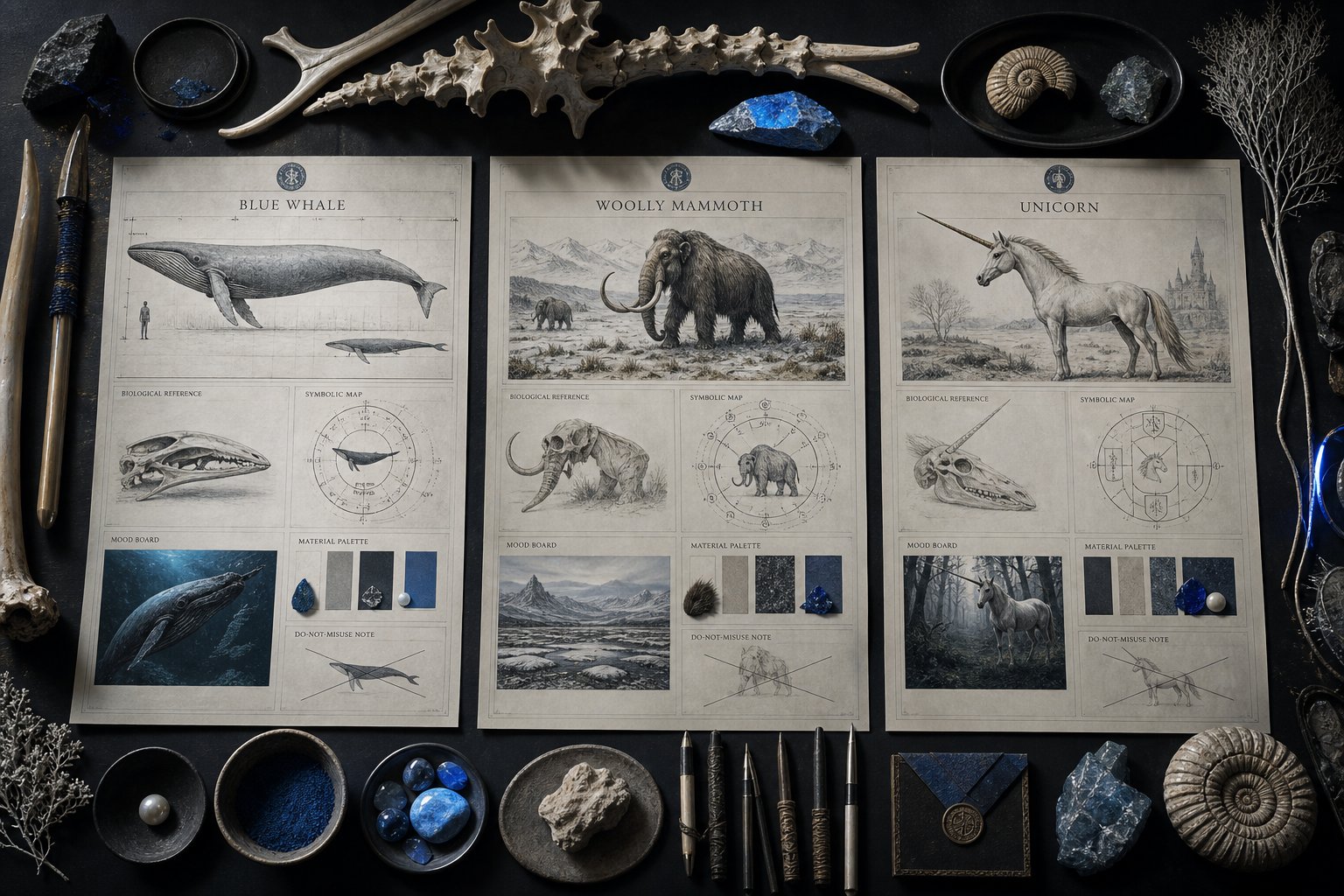
A reference bank for non-human form and meaning: animal bodies, survival mechanisms, mythic symbols, and visual moods held in one disciplined archive.
Premise
Arvolve needs reference with memory, not folders of disconnected images.
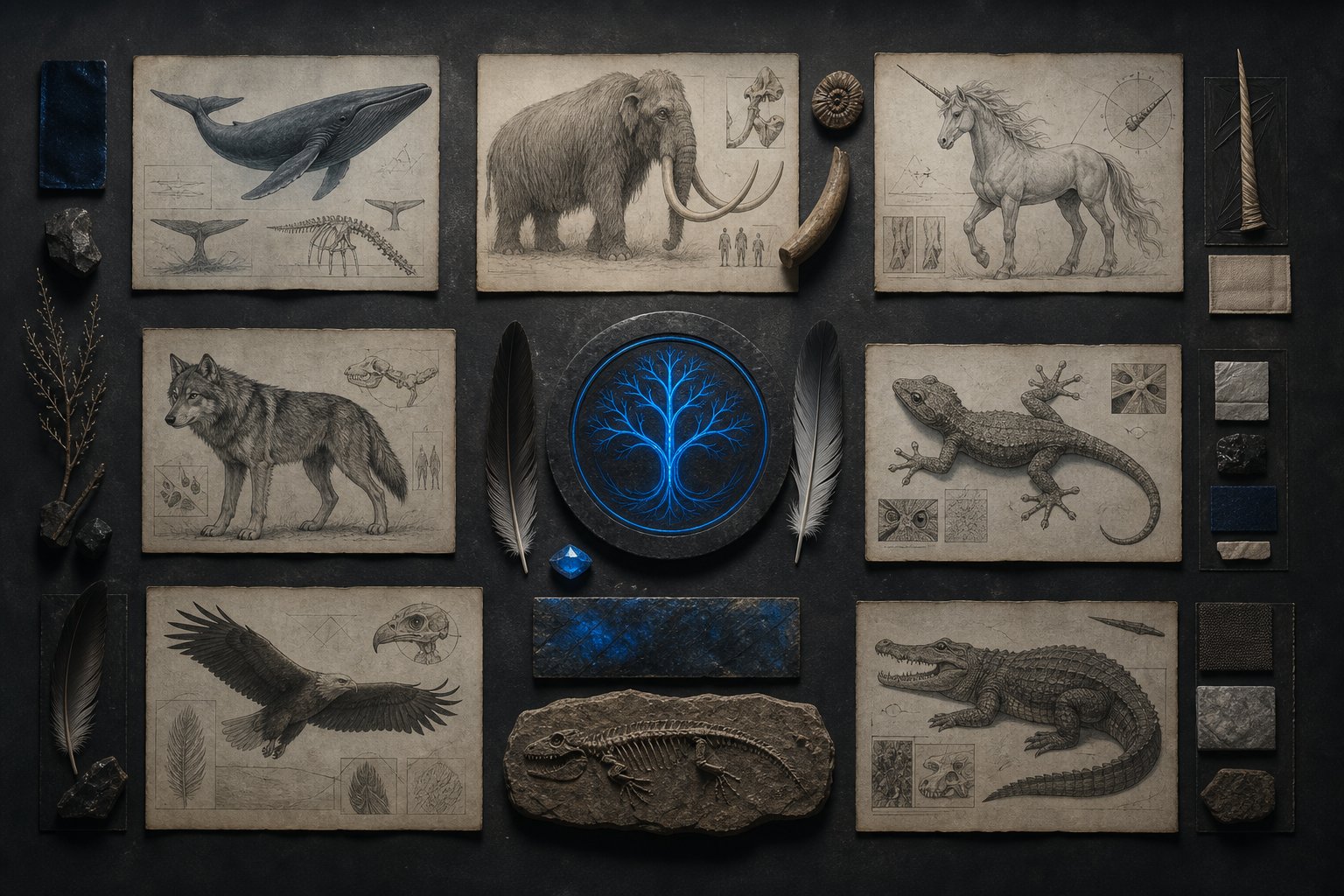
Living Bestiary collects species and creature references into modular atlas cards. Each entry separates biology, behavior, cultural projection, and reusable visual logic.
The first subject set spans extant animals, extinct megafauna, and mythic forms:
- Blue Whale, Grey Wolf, Dromedary Camel, Eurasian Elk, Siberian Reindeer
- Snowy Owl, Saber-Toothed Tiger, Reticulated Giraffe, Woolly Rhinoceros
- Bottlenose Dolphin, Grizzly Bear, Black Panther, Mongolian Wild Horse
- Galapagos Giant Tortoise, Walrus, Komodo Dragon, American Bison
- Woolly Mammoth, Royal Eagle, Flamingo, Gorilla, Unicorn
- Lizard, Gecko, Crocodile
The bank does not create projects by default. It stays dormant until a future brief explicitly asks to activate a subject, trait, mythology, or visual direction.
Why It Matters
Animals compress tested design logic: movement, protection, signaling, adaptation, and symbolic charge. A whale carries scale, resonance, migration, and pressure tolerance. A gecko carries adhesion, lightness, microtexture, and wall logic. A wolf carries pack behavior, endurance, social signaling, and contested symbolism.
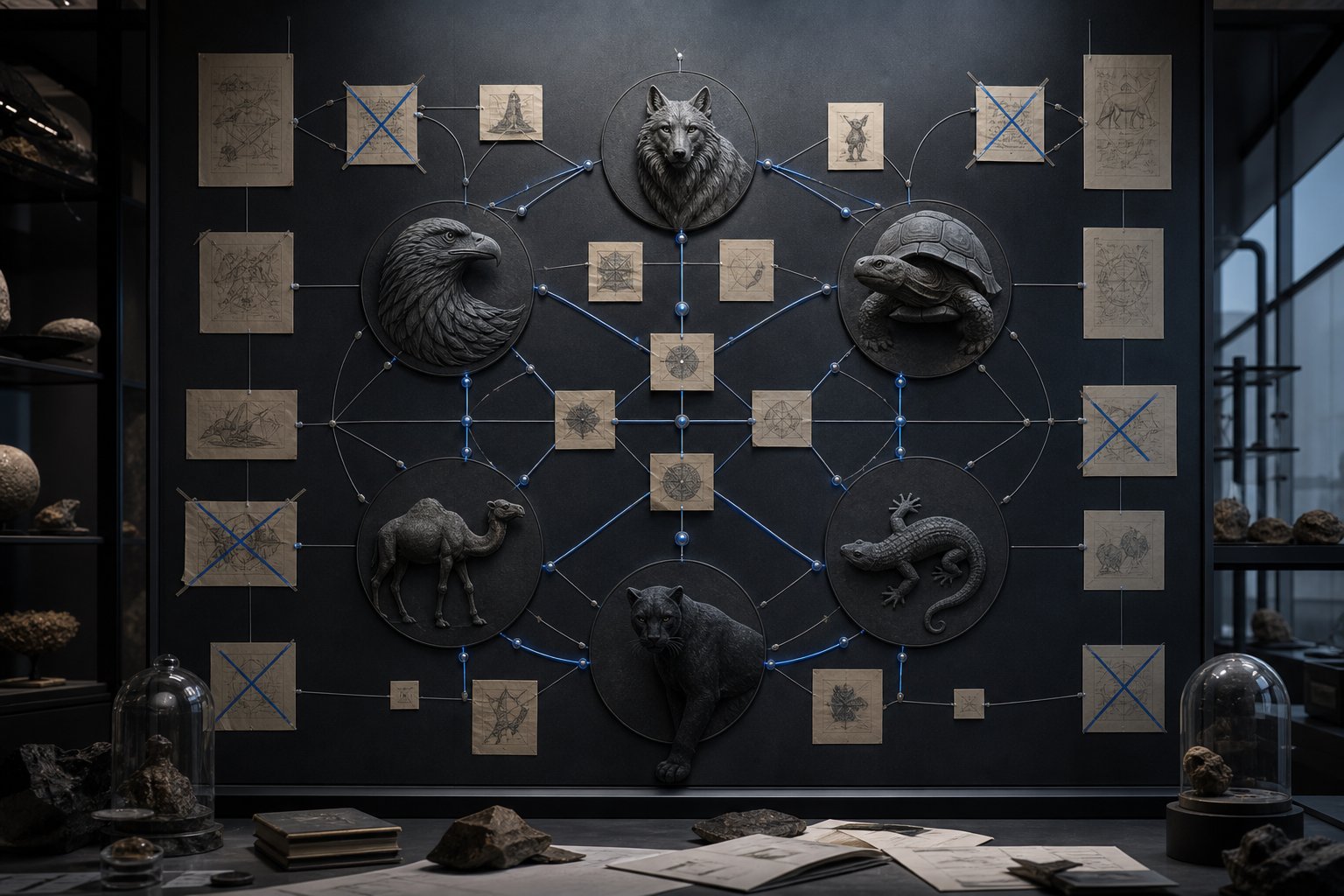
Without structure, these references collapse into clichés: “wolf = strength,” “eagle = freedom,” “tortoise = longevity.” The value is in precision, provenance, and restraint.
The bank preserves:
- Biological mechanism — locomotion, anatomy, sensory bias, habitat pressure.
- Symbolic memory — myth, folklore, ritual use, political charge, cultural ambiguity.
- Visual grammar — silhouette, proportion, rhythm, surface, palette, negative space.
- Design caution — overused metaphors, cultural flattening, false associations.
This creates a reusable substrate for future Arvolve work: product forms, emblems, materials, vehicles, architecture, creatures, interfaces, and speculative systems.
How It Works
Each subject becomes a compact card inside a markdown-first archive, mirrored as visual boards and indexed through ArX for retrieval.
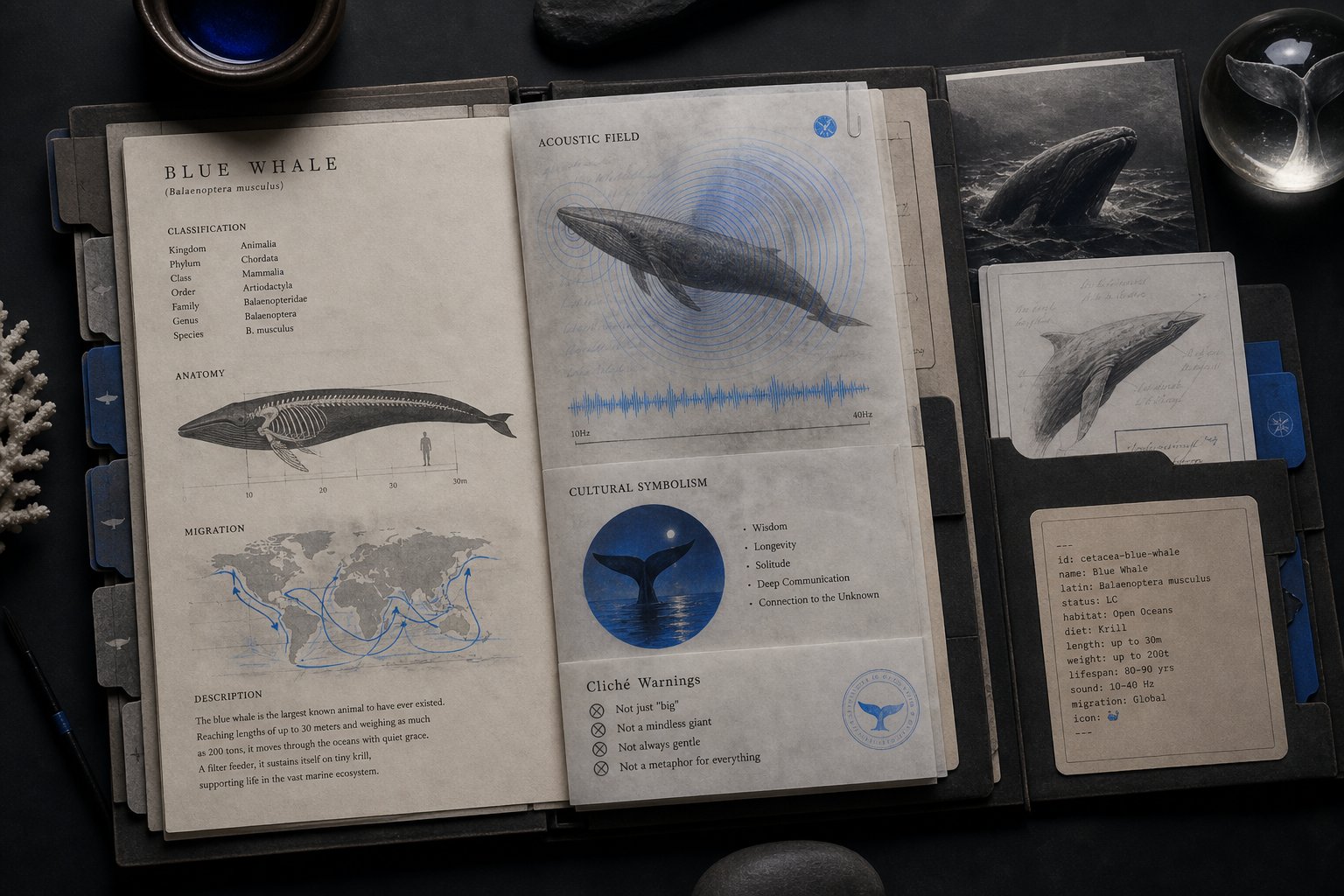
Core fields:
- Classification — extant, extinct, mythic, or hybrid reference.
- Form and motion — skeleton, mass, posture, silhouette, gait, flight, swimming, climbing.
- Survival strategy — defense, cooperation, camouflage, endurance, sensory advantage.
- Habitat pressure — tundra, ocean depth, desert heat, forest density, island isolation.
- Material cues — hide, fur, horn, feather, scale, tusk, baleen, shell, wet skin.
- Symbolic readings — culture, period, source, confidence level, uncertainty.
- Mood and warnings — emotional temperature, cliché risk, sensitivity, misconception.
ArX handles clustering, metadata, mood synthesis, image sorting, and cross-reference retrieval; human curation controls meaning. The archive should not allow an AI-generated association to become truth without source context.
The taxonomy separates categories while allowing bridges. Real animals retain biological specificity. Extinct animals include fossil uncertainty and reconstruction bias. Mythic creatures are treated as symbolic technologies, not zoology. Culturally specific meanings are labeled, not universalized.
Next
Build the first proof as three complete entries, each testing a different category.
- Blue Whale — extant scale, deep time, acoustic space, oceanic solitude.
- Woolly Mammoth — extinct mass, tundra memory, Ice Age engineering, loss.
- Unicorn — mythic purity, impossible anatomy, medieval symbolism, weaponized grace.
Benchmark for completion: each entry contains one biological diagram reference, one symbolic map, one visual mood board, one material palette, and one “do not misuse” note. Each symbolic claim needs provenance: culture, period, source, and confidence level.
After the proof set, expand the list in tiers. Prioritize subjects with high contrast, strong silhouette, rich mythology, and clear biological mechanisms.
Generation Prompts
image-prompt A premium research archive board showing animal reference cards for blue whale, woolly mammoth, unicorn, wolf, gecko, eagle, and crocodile; clean museum-table layout, annotated sketches, fossil notes, symbolic diagrams, material swatches, muted graphite background, warm paper textures, precise minimalist design, cinematic overhead lighting.