Nature-Inspired Design And Biotech Infrastructure
Living Design Grammar translates biological mechanisms into buildable geometries, materials, and tests for objects, robots, and infrastructure.
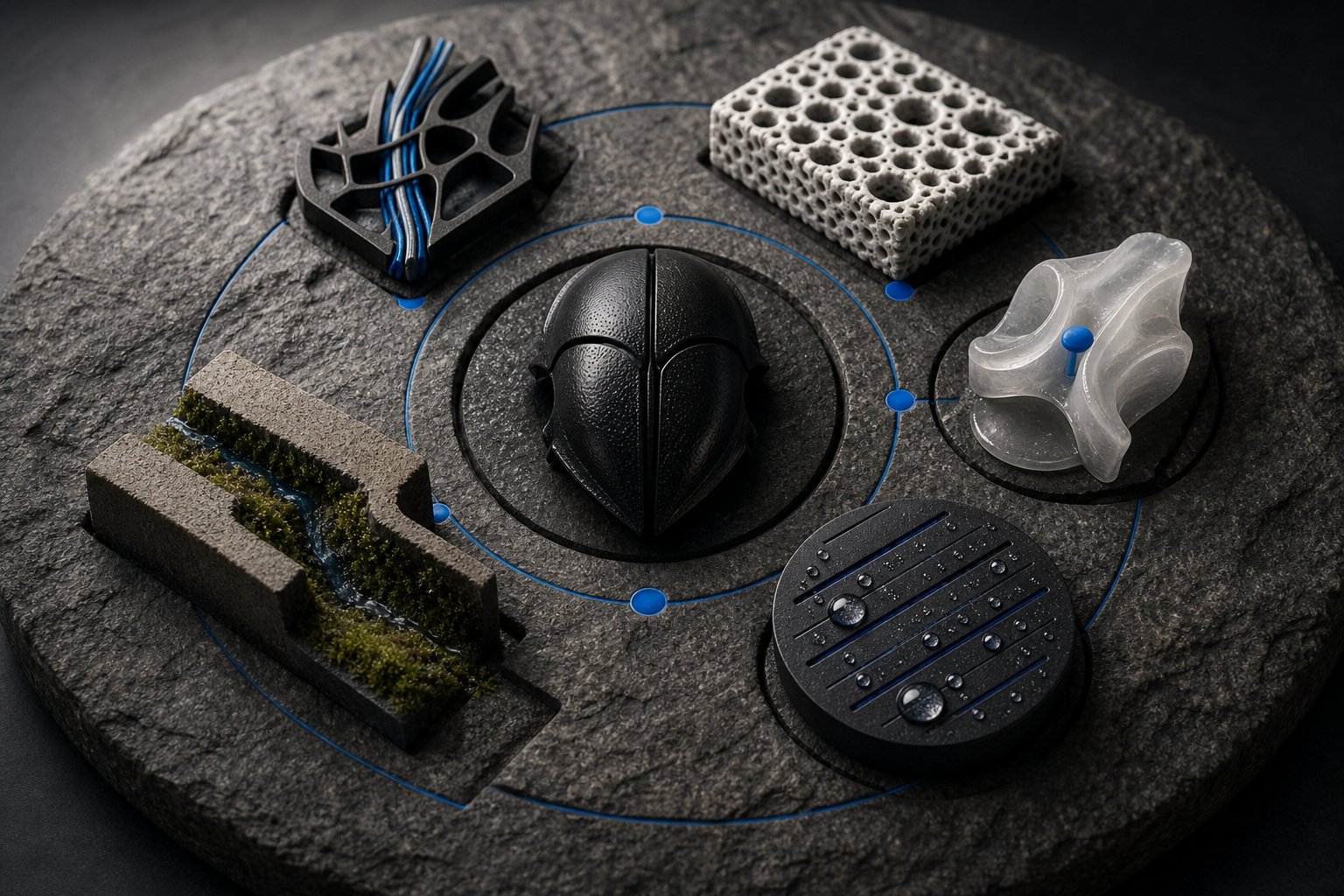
Most organic design copies the curve; this project extracts the load path, flow path, growth rule, or failure response behind it.
Premise
Living Design Grammar is an Arvolve framework for converting biological structure into manufactured behavior, not nature-themed surface styling.
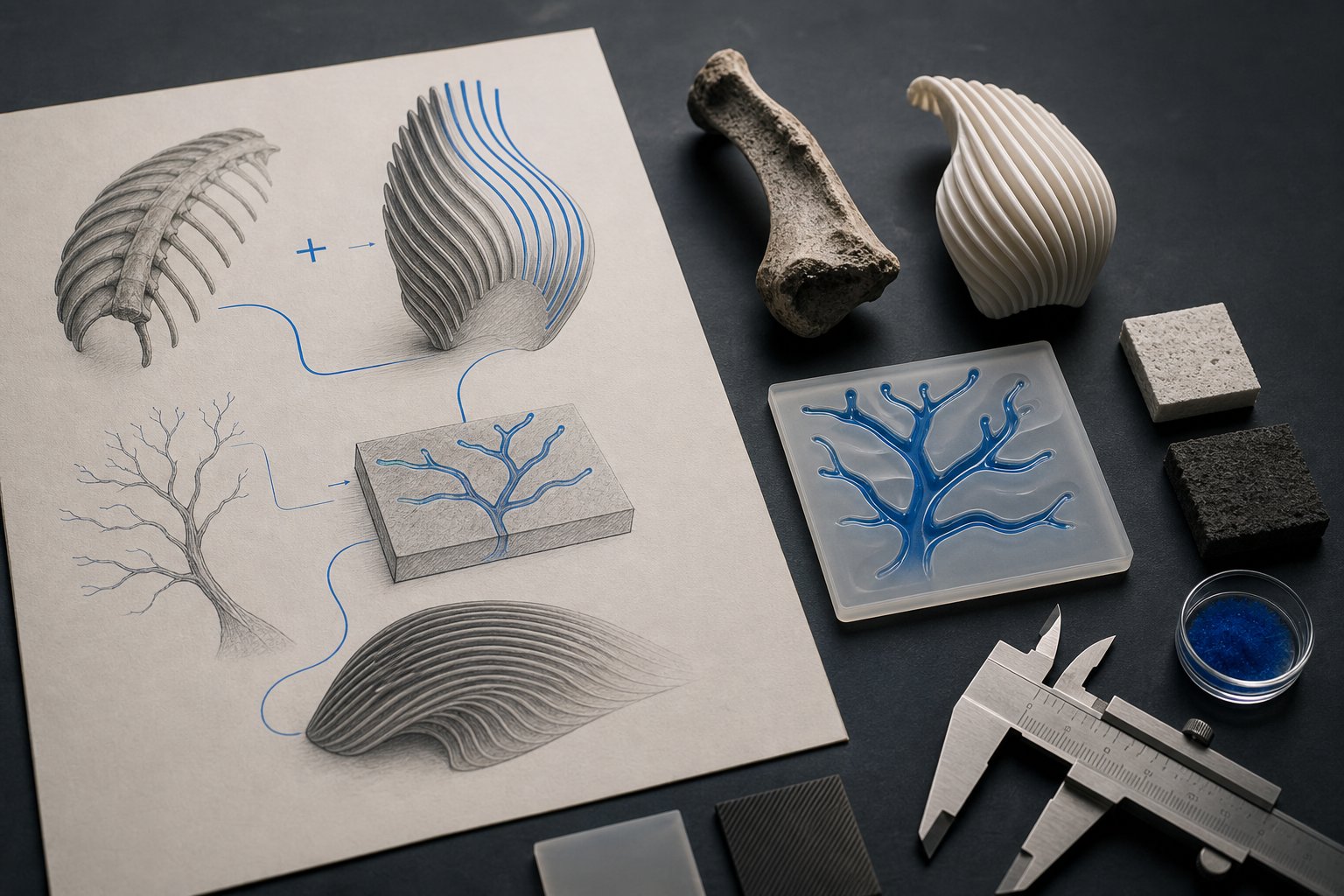
The core move is translation: extract a biological principle, reduce it to a mechanical behavior, rebuild it through digital geometry, material choice, and prototype testing. If the biological reference can be removed without changing the design, the translation failed.
The grammar has three usable levels:
- Biomorphic form: shells, bones, roots, coral, wings, tendons, and cellular lattices as geometry references.
- Biomimetic function: branching, flexion, capillary flow, passive cooling, shock absorption, repair, and growth logic as performance models.
- Bio-integrated systems: controlled objects that host moss, algae, mycelium, microbial films, or plants within defined boundaries.
The goal is not living appearance. The goal is lower material use, better damage tolerance, passive adaptation, and controlled interaction with real environments. Non-goals: decorative biomorphism, uncontrolled living architecture, and sustainability claims without maintenance data.
Why It Matters
Most industrial objects follow a fixed-life model: manufacture, deploy, degrade, replace. Biological systems operate through maintenance, redundancy, repair, shedding, regeneration, and cooperation.
That shift matters when form must survive pressure instead of merely signal style:
- a handle can follow tendon tension paths and test grip pressure distribution;
- a casing can use beetle-like armor logic and compare impact resistance against a plain shell;
- a wall tile can test porous chimney ventilation inspired by termite mound studies;
- a robot joint can use octopus-like soft actuation and measure bend cycles before fatigue;
- a surface can borrow leaf hydrophobicity and track drainage time or water shedding angle;
- a habitat brick can support moss in contained channels and measure survival without spread.
Nature is not gentle. It is constrained, economical, and often brutal. Its value here is not nostalgia, but functional compression: high performance from limited material, energy, and repair capacity.
How It Works
Each biological reference becomes a one-page translation sheet.
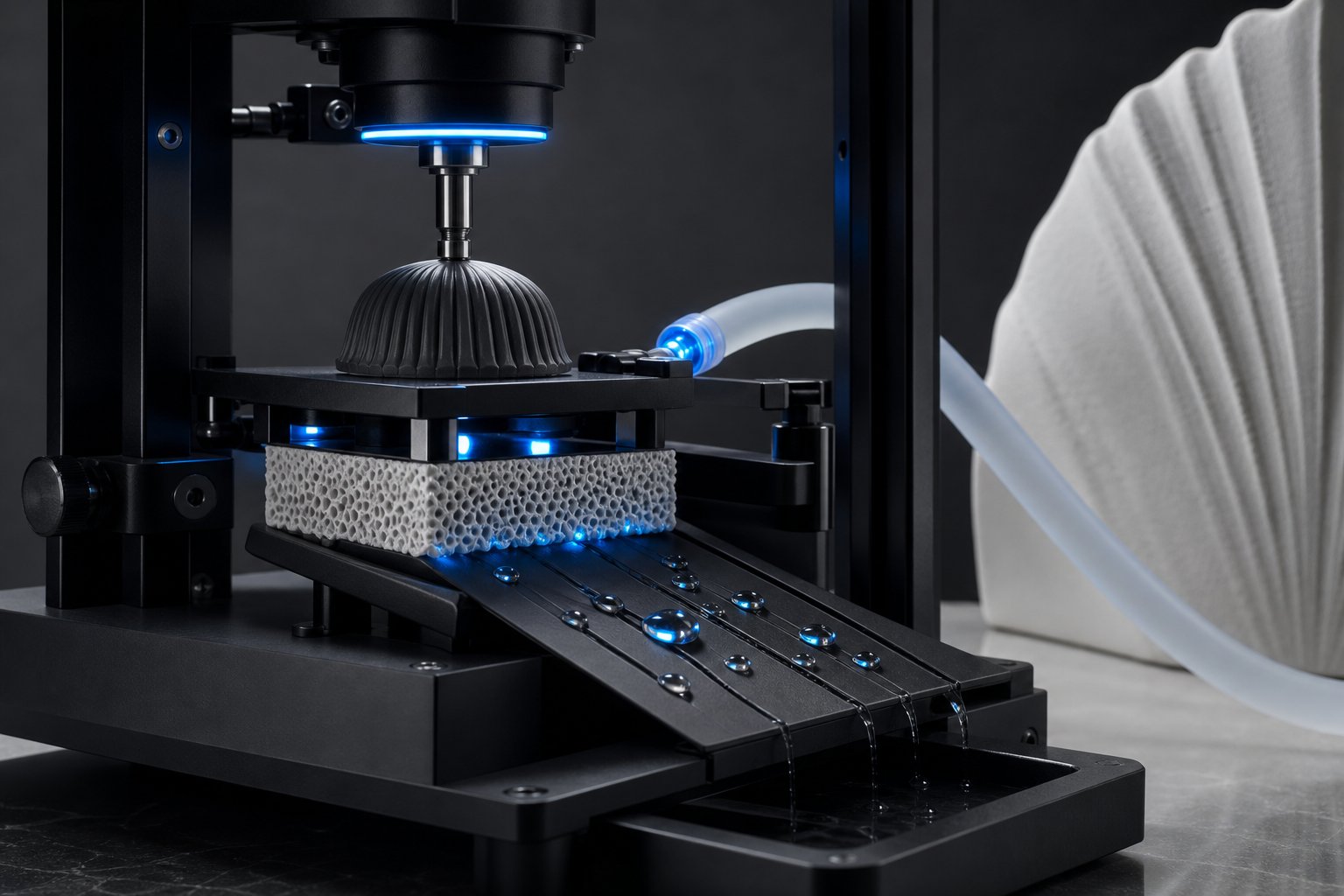
Each sheet defines:
- Source: organism, structure, or behavior being studied.
- Principle: transferable rule, not visual style.
- Geometry: branch, lattice, membrane, hinge, spine, pore, shell, channel, fiber bundle.
- Material path: printed polymer, flexible resin, silicone, composite, ceramic, mycelium, hydrogel-like material, plant substrate.
- Use case: tool, casing, robotic part, architectural skin, cooling tile, habitat brick, drainage surface.
- Failure mode: clogging, fatigue, contamination, overgrowth, brittleness, maintenance burden, fabrication complexity.
- Proof metric: impact strength, airflow rate, temperature delta, grip pressure, bend cycles, drainage time, biological containment.
Proof ladder:
- Near-term: procedural models, FDM/SLA prints, lattice infill tests, flexible polymer joints, airflow rigs, and drainage tests.
- Medium-term: moisture-responsive surfaces, capillary channels, auxetic joints, mycelium composites, and plant-supporting substrates.
- Long-term: containment. Living systems must be bounded, cleaned, fed, monitored, and prevented from becoming invasive maintenance problems.
Next
First proof: a compact taxonomy and six small manufactured tests, not a living robot.
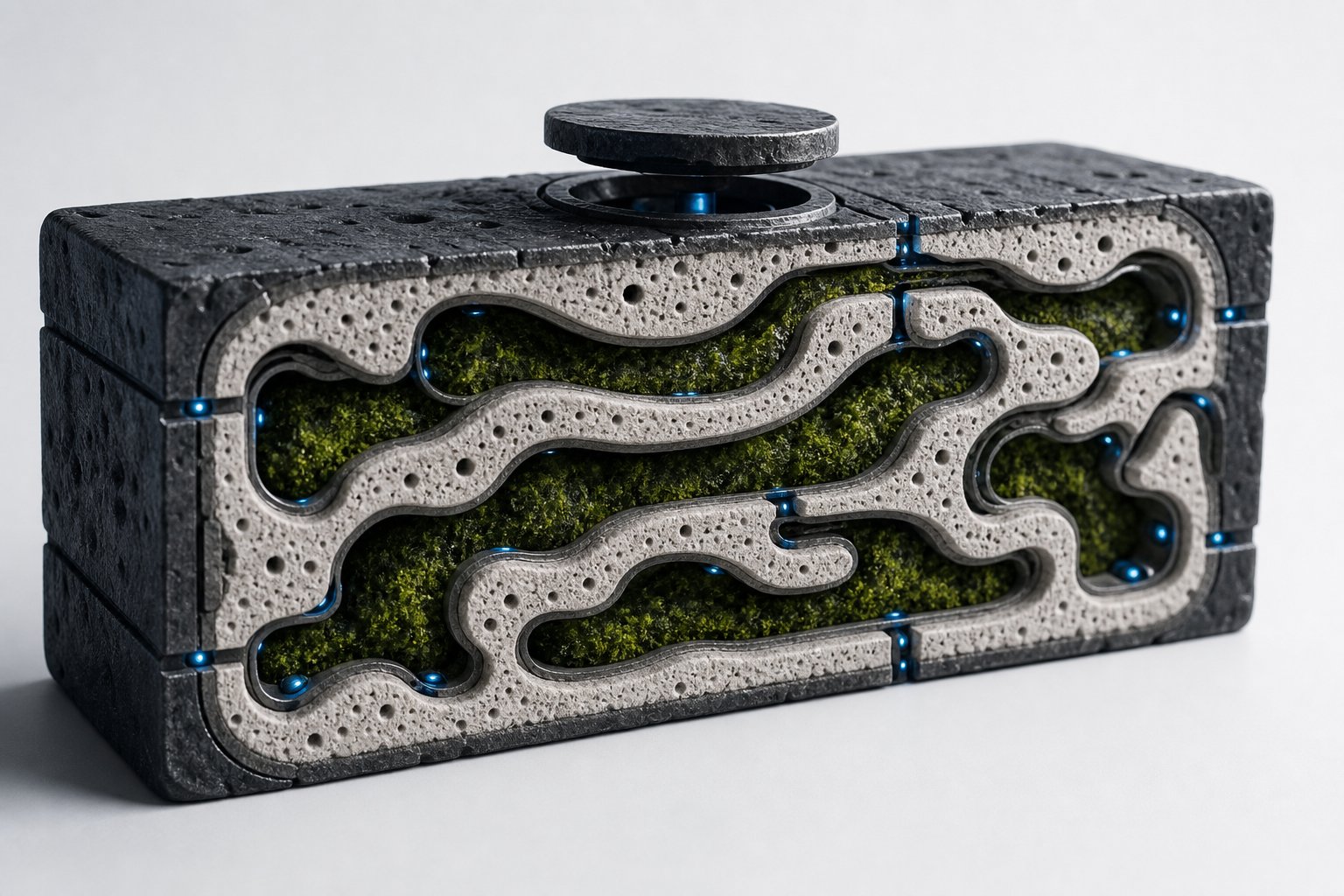
Build 10–20 studies from five mechanisms, then manufacture six: armor, grip, cooling, joint, drainage, habitat channel.
Initial prototype set:
- protective casing based on beetle armor;
- adaptive grip based on tendon paths;
- porous chimney cooling tile inspired by mound ventilation studies;
- flexible joint based on octopus arm mechanics;
- self-draining surface based on leaf hydrophobicity;
- modular habitat brick with a controlled moss channel.
The benchmark is simple: every object must show a clear link between biological source, extracted principle, manufactured geometry, and measurable function. Beauty is allowed, but only after the mechanism survives the test.
Generation Prompts
thumbnail modular biomimetic prototype board, six manufactured tests arranged on warm grey stone, beetle armor casing, tendon-path grip, porous chimney tile, translucent soft joint, hydrophobic drainage plate with water beads, contained moss-channel brick, matte graphite and neutral materials with electric blue test markers, controlled studio lighting, hyper-real 3:2 hero composition
failure-rig compact testing rig for biomimetic objects, ribbed protective casing under impact probe, porous cooling tile connected to airflow tube, drainage surface tilted with controlled water beads, sensors glowing electric blue, off-black metal frame and matte polymer parts, clean laboratory composition, sharp side-angle view, hyper-real material detail
moss-channel modular habitat brick cross-section, contained moss growing only inside sealed serpentine channels, porous ceramic body with graphite outer shell and removable maintenance cover, tiny moisture ports highlighted in electric blue, no spread beyond boundaries, cool neutral studio background, macro cutaway perspective, crisp photoreal finish
translation-sheet biological translation workstation, one-page principle sheet beside physical samples, shell rib fragment mapped into ribbed casing geometry, branching channel diagram etched into polymer tile, small material swatches and calipers, matte charcoal desk with soft neutral papers and electric blue annotation lines, crisp overhead studio lighting, photoreal technical clarity