Spherical Evolutionary Neural Architecture
A graph neural network arranged as nested spherical shells tests whether radial compression improves body-centered spatial reasoning under noise, occlusion, and limited samples.
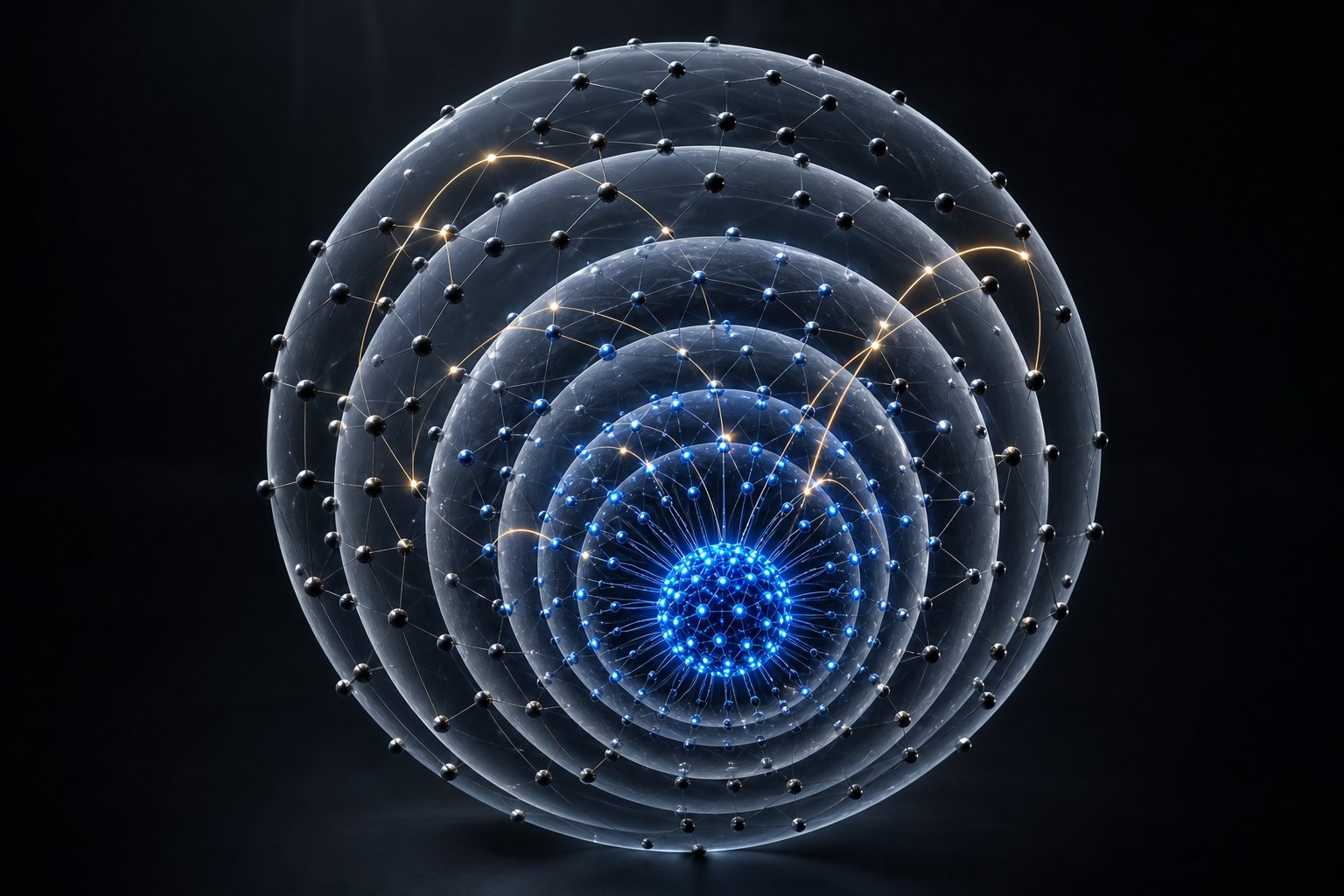
Most neural networks erase body-centered geometry before reasoning begins. Concentric Cortex tests the opposite bias: computation starts on an outer sensory surface and compresses inward toward action.
Premise
Embodied agents receive direction, distance, touch, motion, field intensity, occlusion, and changing spatial relations around a body. Flattening those signals may discard structure before the model can use it.
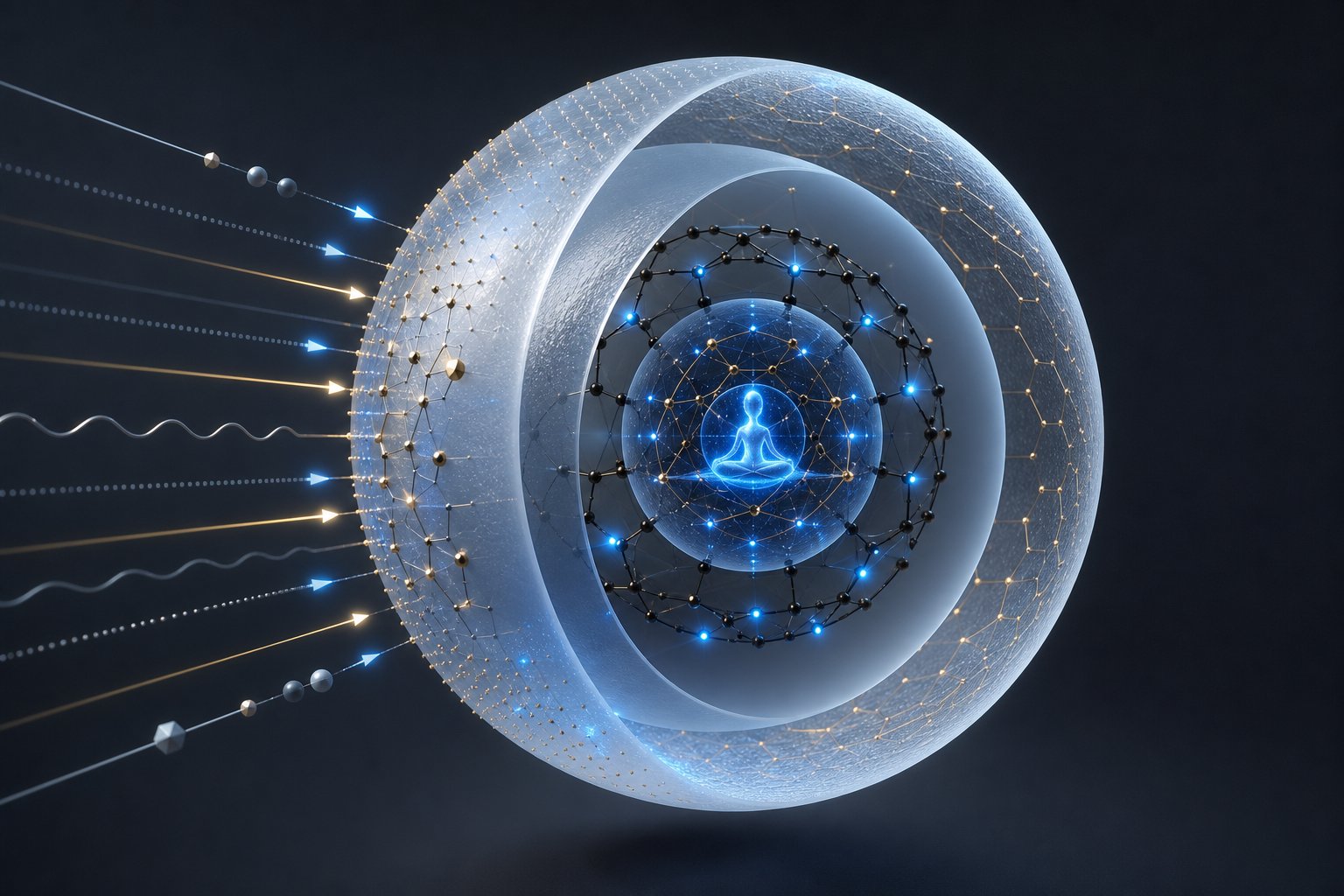
The project proposes a neural architecture built from concentric spherical layers:
- outer shells encode sensory contact, direction, or spatial input
- middle shells bind local signals into larger patterns
- inner shells compress those patterns into decisions, actions, or latent state
- sparse pathways connect nearby nodes, adjacent shells, and rare long-range shortcuts
The sphere is the prior: angular position encodes direction, radial depth encodes abstraction. A node near the surface is close to sensing. A node near the core is close to action selection.
Why It Matters
Many architectures can learn geometry, but few are forced to preserve body-centered direction from the first layer. Transformers can model spatial relations, CNNs preserve local grids, and graph neural networks handle arbitrary relations, but none automatically create a sensor-to-core compression path.
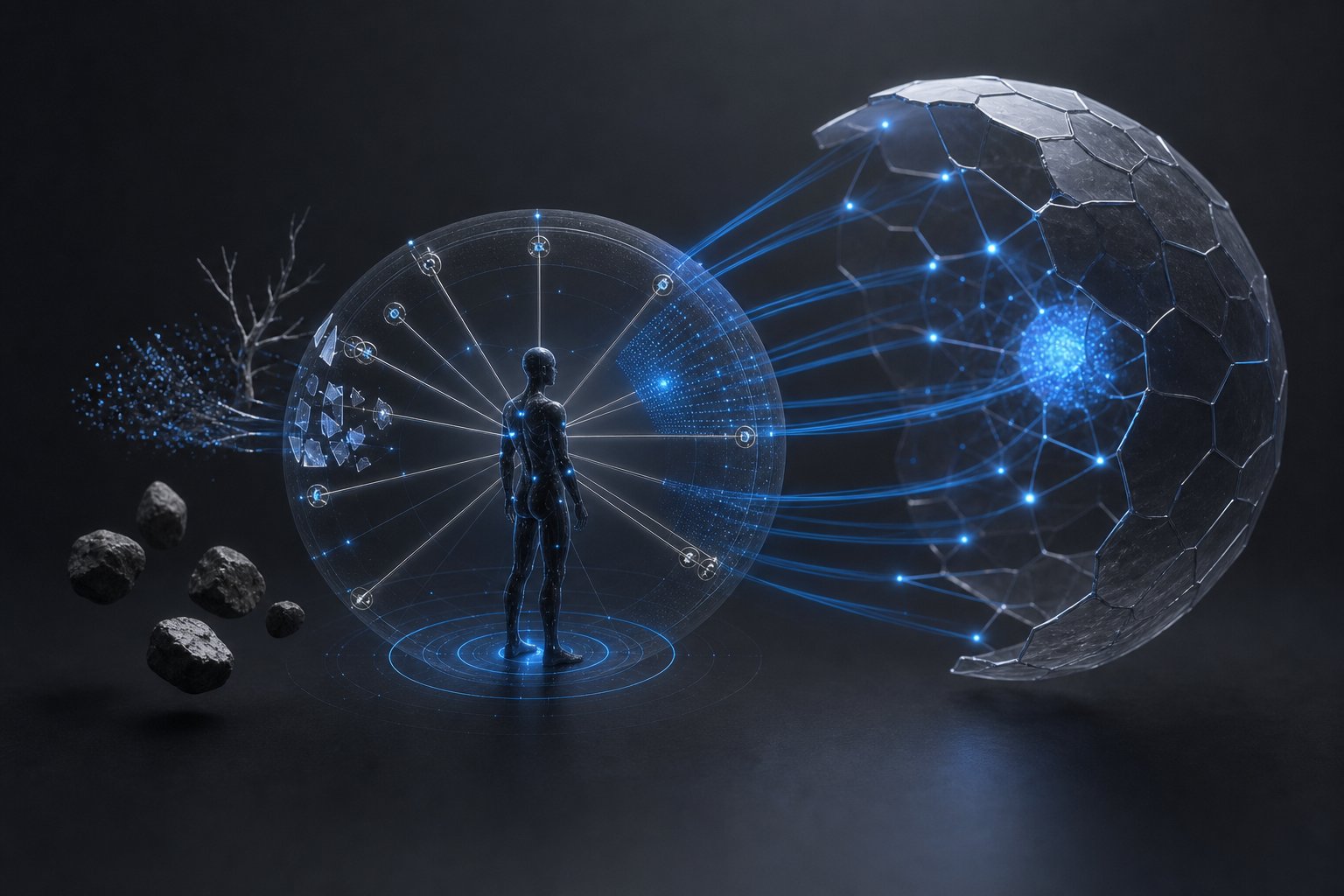
A spherical topology may help where the task itself is radial, spatial, or agent-centered:
- navigation from directional range sensors
- object localization around a moving body
- sensor fusion across touch, vision, proximity, and motion
- robot control with body-relative observations
- 3D scene reasoning where orientation matters
Adjacent work includes spherical CNNs, graph neural networks, neural architecture search, and neuroevolution. Concentric Cortex differs only if radial sensor-to-core compression beats size-matched alternatives.
The claim is modest: not general intelligence, but a useful inductive bias for problems where geometry and hierarchy are part of the task.
How It Works
The architecture is implemented as a graph neural network with nodes placed on nested spherical shells.

Initial input mapping should be explicit:
- range rays become angular bins on the outer shell
- tactile patches map to body-surface coordinates
- vision features project into a view-centered shell or learned spherical embedding
Each node holds an activation state. Edges define information flow:
- Lateral links: nearby nodes on the same shell exchange local spatial context.
- Radial links: adjacent shells compress or expand information between sensing and decision layers.
- Shortcut links: sparse cross-shell edges bypass depth when search finds a useful route.
Training uses two adaptation loops:
- Gradient learning tunes edge weights and node functions.
- Evolutionary search mutates wiring geometry: shell count, node density, edge sparsity, shortcut probability, radial fan-in, and neighborhood size.
This avoids evolving every weight from scratch. Evolution searches wiring geometry; gradient descent fits behavior.
The risks are concrete. Radial compression may discard useful local detail. Gains may come from sparsity rather than spherical structure. Topology search may overfit small benchmarks. The idea only matters if it beats size-matched baselines; biological resemblance is not evidence.
Comparison targets:
- MLP with similar parameter count
- CNN or spherical CNN where applicable
- standard graph neural network
- sparse random graph network
- hand-designed radial graph without evolution
Next
Build a minimal simulator with 3–7 concentric shells and a fixed node budget. Start with short embodied tasks before touching robotics hardware.
First benchmark set:
- 2D navigation from radial distance sensors
- 3D object direction classification
- noisy sensor fusion with missing inputs
- small agent control with body-relative observations
Success criteria:
- equal or better accuracy with fewer samples
- stronger robustness under sensor noise or occlusion
- interpretable routing from surface regions to core decisions
- topology patterns that repeat across random seeds
The next proof is an ablation, not a scale-up: same task, same parameter budget, different topology. If the concentric graph improves spatial generalization or sensor robustness across seeds, the architecture becomes worth scaling.
Generation Prompts
thumbnail Concentric spherical graph neural architecture floating in darkness, five translucent nested shells packed with precise glowing nodes, radial compression paths converging into a dense inner action core, sparse shortcut edges arcing across layers in warm gold, matte graphite environment, blue-violet signal glow, studio-lit hyper-real CGI, sharp 3:2 hero composition for small card readability
sensor-fusion Embodied agent silhouette surrounded by a spherical sensor field, range beams, touch points, vision fragments, and motion vectors projected onto an outer neural shell, signals preserved as angular positions before compressing inward, minimal premium materials, graphite matte ground, blue family as single hero glow, soft studio lighting, hyper-real explanatory CGI, wide 3:2 frame
shell-prior Cutaway view of body-centered computation mapped onto nested spherical shells, outer surface receiving directional rays, distance pulses, tactile patches, and occlusion shadows, middle layers binding local neighborhoods, inner core abstracting decisions, frosted glass shells and matte black node lattice, cool blue illumination with restrained gold accents, parametric scientific render, clean 3:2 composition
topology-search Mechanism diagram of evolutionary graph search inside concentric neural shells, lateral neighborhood links drawn as tight surface meshes, radial fan-in paths stepping inward, rare shortcut mutations highlighted in warm gold, ghosted alternative shell densities and sparsity patterns orbiting nearby, matte translucent materials, precise technical lighting, hyper-real parametric visualization, 3:2 aspect